
Learning how to increase organic traffic isn’t just a numbers game or a keyword-stuffing exercise. It's about methodically building a digital asset that people—and Google—trust.
The whole process boils down to three core pillars: a rock-solid technical foundation, creating content that genuinely solves problems, and earning authority with high-quality links. Get these right, and you’re not just chasing rankings; you're building a reliable machine that attracts high-intent customers for the long haul.
Why Organic Traffic Is Your Most Valuable Asset
Sure, paid ads and social media can give you a quick traffic spike, but organic search is the foundation for lasting growth. It's the difference between renting an audience for a day and owning a relationship for years.
When someone finds you through a Google search, their mindset is completely different. They aren't doomscrolling; they’re actively looking for an answer, a product, or a solution. That intent is gold. It’s what makes organic visitors so much more valuable than casual browsers.
Over time, this builds incredible trust and credibility. An ad vanishes the second your budget runs out, but a top-ranking article can be a lead-generation engine for years, working for you 24/7. This creates a powerful flywheel: great content builds authority, which earns higher rankings, which drives more traffic.
The Unmatched ROI of Search
The data doesn't lie. Organic search is the single biggest driver of website traffic, period. It's responsible for a massive 53% of all website traffic globally, blowing social media out of the water and getting 10 times more clicks than paid ads.
For local businesses, it gets even better. A well-executed local SEO strategy can ramp up conversions by over 300%. These aren't just vanity metrics; they're statistics that underscore the real-world impact of a smart SEO plan.
It all comes back to a simple, powerful loop: earning trust through great content delivers a far better return on investment, which in turn feeds your business with a steady stream of qualified leads.
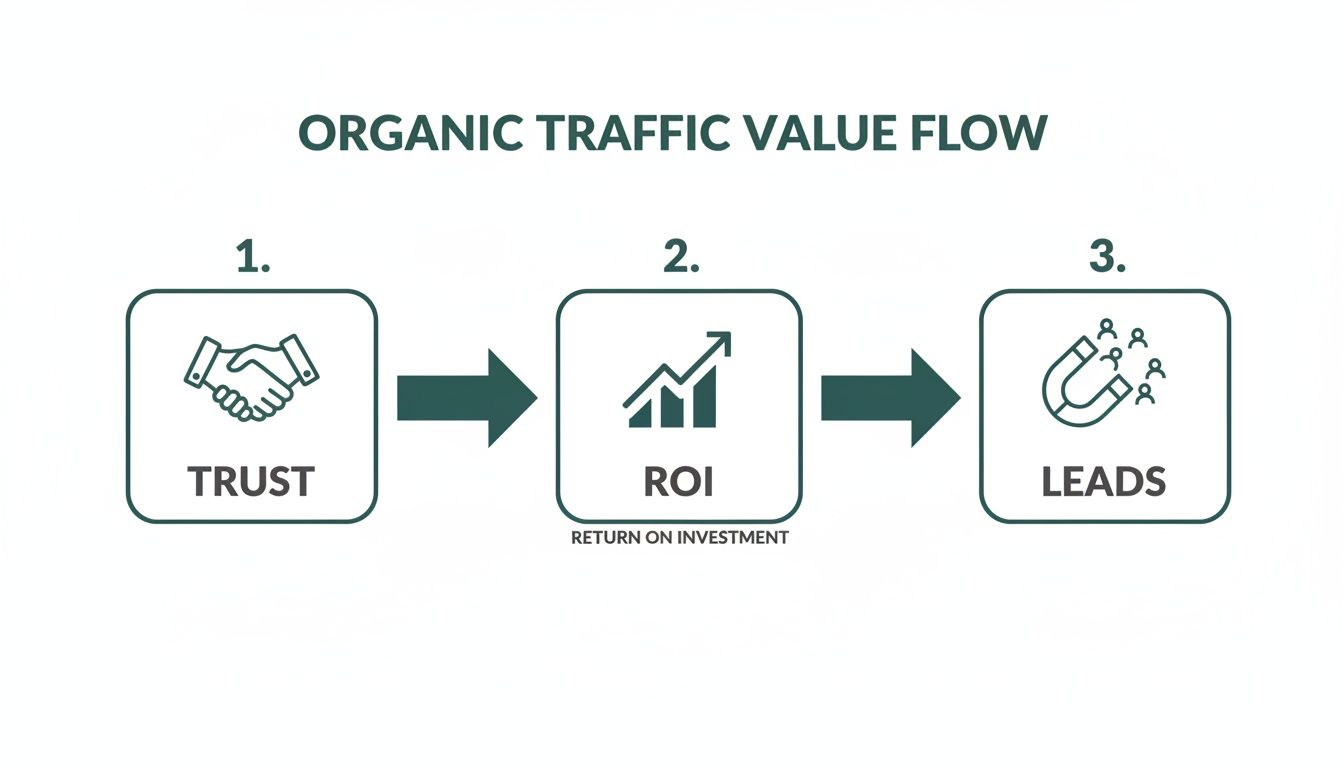
By establishing that credibility, you're not just getting clicks—you're creating a business asset that pays dividends long after you've published the content.
A Sustainable Growth Engine
To really get it, think about it this way: SEO is like building a factory. Paid ads are like renting someone else's.
The factory takes some upfront investment—time, effort, resources—but once it's up and running, it produces value consistently with minimal ongoing costs. This is how you drive down your customer acquisition cost (CAC) over time and build a more profitable business.
A strategic, integrated approach is the key to turning your website into a powerful engine for qualified leads. It’s not just about getting more visitors; it’s about attracting the right ones who are ready to engage.
Ultimately, investing in your organic traffic is investing in a durable asset that grows in value, strengthens your brand, and puts you in front of your ideal customers right when they need you most.
Organic Traffic vs Paid Channels: A Head-to-Head Comparison
It's helpful to see exactly how organic search stacks up against the other major channels. Each has its place, but the long-term strengths of SEO are hard to ignore.
| Attribute | Organic Search (SEO) | Paid Search (PPC) | Social Media |
|---|---|---|---|
| Trust & Credibility | Very High. Earned rankings are seen as more trustworthy. | Low to Medium. Users know it's a paid placement. | Medium. Depends on brand reputation and engagement. |
| Cost Over Time | Decreases. High upfront investment, low ongoing cost. | Stable to Increasing. Pay-per-click model. | Increasing. Requires constant ad spend and content creation. |
| Long-Term Value | High & Compounding. Content can rank for years. | None. Traffic stops the moment you stop paying. | Low. Content has a very short lifespan. |
| User Intent | High. Users are actively searching for solutions. | High. Can be precisely targeted by keywords. | Low. Users are primarily browsing, not buying. |
| Time to Results | Slow. Can take months to see significant results. | Immediate. Traffic starts as soon as the campaign is live. | Fast. Can go viral or drive immediate engagement. |
While paid channels offer speed, organic search delivers something far more valuable in the long run: sustainability, trust, and a compounding return on your investment.
Building a Rock-Solid Technical SEO Foundation
Let’s think about your website like a high-performance car for a moment. You can have the most powerful engine in the world—that's your content—but if the chassis is weak, the fuel lines are clogged, or the steering is shot, you're not going anywhere fast. Technical SEO is that chassis. It's the critical groundwork that lets search engines like Google easily find, understand, and trust your website enough to show it to people.
One of the biggest mistakes I see businesses make is pouring all their resources into content while completely ignoring this foundation. You could have the most brilliant blog posts and killer service pages, but if Google's crawlers can't access them or get confused trying to navigate your site, it’s all for nothing. Your content becomes invisible.
So, let's get your site’s technical health in order. This is how you give your great content a real fighting chance.
Prioritize Website Speed and Core Web Vitals
A slow website is the digital equivalent of a store with a jammed door. Nobody's sticking around to fight with it. We live in an impatient world, and if a page takes more than three seconds to load, you can bet over half of your mobile visitors are already gone.
This isn't just about user frustration; it's a direct signal to Google. That's why they introduced Core Web Vitals, a set of specific metrics that have become a direct ranking factor.
These vitals zoom in on three key parts of the user experience:
- Largest Contentful Paint (LCP): Basically, how fast does the most important stuff on the page show up?
- Interaction to Next Paint (INP): When a user clicks a button, how quickly does the site actually respond?
- Cumulative Layout Shift (CLS): Does the page jump around annoyingly as it loads, causing users to misclick?
You don't need to be a coding wizard to tackle this. A great first step is to run your site through Google's PageSpeed Insights tool. It spits out a score and, more importantly, a list of specific things to fix. Usually, the biggest culprits are massive, unoptimized images or clunky plugins slowing everything down.
A fast, responsive website isn't just a "nice-to-have"; it's a fundamental signal to Google that you value your users' time. Fixing speed issues is often the lowest-hanging fruit for a quick and satisfying SEO win.
Master Mobile-First Design and Clean URLs
The world has gone mobile. With the majority of Google searches now happening on smartphones, Google itself has adopted mobile-first indexing. This means it primarily looks at the mobile version of your website to decide how to rank it. Your site must look and work flawlessly on a phone. No exceptions. A clunky mobile experience will tank your rankings, guaranteed.
This is why a responsive design is completely non-negotiable. It allows your website to automatically resize and reformat to fit any screen, from a tiny phone to a giant desktop monitor, giving every visitor a smooth experience. You can dive deeper into why responsive web design matters for SEO in our dedicated guide.
Just as important is a clean, logical URL structure. A good URL acts like a miniature signpost, telling both users and search engines what the page is about before they even get there.
Look at the difference:
- Bad URL:
yourdomain.com/index.php?category=12&product_id=567 - Good URL:
yourdomain.com/services/local-seo-audits
The second one is clear, descriptive, and even includes keywords. It gives Google a strong hint about the page's content, making it far easier to rank for the right terms.
Secure Your Site with HTTPS
Finally, let's talk security. That little padlock icon you see in the browser's address bar comes from an SSL certificate, which enables HTTPS to encrypt the connection between a user and your website.
Google has stated that HTTPS is a lightweight ranking signal, but its real power is as a massive trust signal for your visitors. Modern browsers like Chrome don't mess around; they'll slap a big "Not Secure" warning on any site that isn't using HTTPS. That's enough to scare away potential customers in a heartbeat.
Getting an SSL certificate is thankfully pretty simple these days. Many web hosting providers even offer them for free. It’s a simple, one-time setup that protects your users, builds credibility, and checks a crucial box for modern SEO.
Creating Content That People and Search Engines Love

With a clean technical setup, we can shift our focus to the heart and soul of SEO: your content. Let's be honest, technical fixes are essential, but they don't build a brand or earn trust. For that, you need to create content that genuinely helps your audience while clearly signaling your expertise to search engines.
This is the balancing act where so many businesses stumble. They either write for people with zero thought for search, or they cram so many keywords into an article that it becomes unreadable. The sweet spot is creating truly valuable resources that are also built to be discovered. It’s not about tricking Google; it’s about figuring out what your customers are asking and then providing the absolute best answer.
The whole game changes when you stop asking "What do I want to sell?" and start asking "What does my audience need to know?"
Uncovering Customer Questions With Keyword Research
Before you write a single word, you have to learn the language your customers use. Keyword research is simply the process of finding the exact phrases people type into Google when they’re looking for the solutions you offer. It’s the bedrock of any content strategy that aims to increase organic traffic.
You have to think beyond the obvious service terms. The real gold is in long-tail keywords—longer, more specific phrases that reveal exactly what a person is thinking. For a landscaper, instead of just targeting "landscaping," you'd look for queries like:
- "drought-tolerant landscaping ideas for San Diego"
- "how much does a backyard renovation cost"
- "best low-maintenance plants for Southern California"
These highly specific searches usually have less competition and, more importantly, attract people who are much closer to making a decision. Tools like Ahrefs or SEMrush are fantastic for this, but don't overlook the freebies. Google’s own search bar, with its autocomplete suggestions and "People also ask" section, can be a goldmine.
Organizing Your Content With Topic Clusters
Once you have your list of keywords, resist the urge to start writing a bunch of disconnected blog posts. To build real authority in Google's eyes, you need to organize your content into topic clusters.
The model is simple but powerful. You create one massive, comprehensive "pillar page" on a broad topic. Then, you surround it with shorter, more focused "cluster" articles that dive deep into specific subtopics.
Imagine you're a local roofer. Your pillar page might be "The Ultimate Guide to Roof Replacement." Your cluster content would then be individual articles covering things like:
- "Choosing the Best Roofing Materials for Your Climate"
- "5 Telltale Signs You Need a New Roof"
- "How to Budget for a Full Roof Replacement"
Every one of these cluster posts links back to the main pillar page. This structure is brilliant because it helps users easily explore the topic, and it sends a massive signal to Google that you're an expert on the entire subject, which helps boost your rankings across the board.
Building out topic clusters is a strategic way to show Google you're not just a source for one keyword, but an authority on an entire subject. This is how you win bigger, more valuable search terms over time.
Crafting Content That Truly Delivers Value
Alright, it's time to actually create the content. The bar for what's considered "good" is higher than ever. To stand out, your content simply has to be better than what's already ranking on page one of Google. That means being more thorough, offering a unique perspective, or just being more helpful and engaging.
Start by Googling your target keyword and analyzing the top results. What questions are they answering? What format are they using? Your mission is to create something that covers the topic more completely or presents the information in a much clearer way. For B2B businesses, this is non-negotiable; research shows 71% of buyers start their journey with a generic search and review three to five pieces of content before ever speaking to a sales rep.
And the prize for doing this well is huge. Landing that #1 spot isn't just for bragging rights—it captures a massive 34% click-through rate on desktop. In fact, the top three results combined get 75% of all clicks. Meanwhile, page two is a wasteland, getting just 0.78% CTR. These aren't just numbers; they’re a clear mandate for any business aiming for real growth. You can explore more SEO statistics that drive this point home.
Matching Content Formats to Customer Intent
Not all content is created equal, and choosing the right format is key to connecting with your audience at the right time. A person just starting their research has different needs than someone ready to buy. This table will help you map your content ideas to the different stages of the buyer's journey.
| Customer Stage | Primary Goal | Effective Blog Format | Effective Video Format |
|---|---|---|---|
| Awareness | Educate & Inform | How-To Guides, Listicles, Industry News | Explainer Videos, "What Is…" Shorts |
| Consideration | Compare & Evaluate | Comparison Posts, Case Studies, Buying Guides | Product Demos, Feature Walkthroughs |
| Decision | Validate & Convert | Customer Testimonials, Pricing Breakdowns | "Why Us" Videos, Onboarding Tutorials |
By aligning your format with the user's intent, you create a much more natural and effective path from discovery to conversion.
To make your content compelling, use a mix of media. Short, scannable paragraphs, bullet points, and clear headings are a must. But don't stop there. Adding custom images, infographics, and especially short videos can dramatically increase how long people stick around—a huge positive signal to Google. When you focus on being genuinely helpful, you can't help but attract the right kind of traffic.
Dominating Local Search with Google Business Profile

If your business has a physical location or serves a specific local area, your Google Business Profile (GBP) is your single most important marketing tool. Hands down. This isn't just another online directory; it's your digital storefront on the world's biggest search engine.
When someone in your town searches for "plumber near me" or "best coffee shop in downtown," a perfectly optimized GBP is what lands you in that all-important "map pack" at the top of the results. Neglecting it is like having a billboard but keeping it turned off.
Turning Your Profile into a Customer Magnet
Think of your GBP as much more than a static listing with your name and address. It's an interactive preview of your business, and it’s where most local customers will form their first impression of you. A completely filled-out profile sends a powerful signal to Google that you’re active, legitimate, and a business it should recommend.
It sounds almost too simple, but the first step is to fill out every single field. You'd be surprised how many businesses leave huge chunks of their profile blank. That means adding multiple business categories, clearly defining your service area, and detailing all of your products and services right there on the profile.
A complete and active Google Business Profile is a massive trust signal. It tells both customers and Google that you are a serious, operational business ready to serve your community.
Choosing the Right Business Categories
This is one of the most critical parts of the setup, so don't rush it. Your primary category needs to be the most accurate, specific description of what you do. For instance, don't just pick "Restaurant" if you're actually a "Pizza Restaurant." That specificity matters.
Once you’ve locked in your primary category, it’s time to add secondary categories that cover the other things you offer. This is how you show up in a much wider net of relevant searches. A "Landscaper" could (and should) also add categories like:
- Lawn Care Service
- Irrigation System Contractor
- Landscape Designer
These extra layers help you capture people searching for more specific, high-intent terms, all without weakening the focus of your main service.
The Power of Local Keywords and Service Descriptions
With the fundamentals in place, you can start weaving in local keywords. This is your chance to explicitly tell Google which neighborhoods and cities you serve. Instead of just listing a service like "Roof Repair," you should be describing it as "Residential Roof Repair in San Diego."
Make full use of the dedicated sections for services and products. Write rich, detailed descriptions for everything you offer, and naturally work in the phrases your customers are actually searching for. Google indexes this information, and it has a direct impact on your ranking for those service-related queries. If you’re a local business, you need to master this process. Check out our comprehensive guide on SEO marketing for local businesses to dive deeper.
Building Trust with Reviews and Photos
In the world of local search, social proof is king. Reviews are a known ranking factor, and having a consistent flow of positive feedback is non-negotiable. Don't be passive—actively ask your happy customers to leave a review. Then, make it a non-negotiable part of your routine to respond to every single one, good or bad. A thoughtful reply to a negative review can often be more powerful than ten positive ones.
Photos and videos are what bring your profile to life. People want to see your work, meet your team, and get a feel for your location before they ever contact you. Get in the habit of regularly uploading high-quality, recent images.
- Showcase Your Work: Before-and-after photos are pure gold for any service-based business.
- Introduce Your Team: Putting a face to the name builds an immediate personal connection and fosters trust.
- Display Your Location: Clear shots of your interior and exterior make potential customers feel more comfortable visiting.
Using GBP Posts and the Q&A to Your Advantage
Think of Google Business Profile Posts as free mini-ads that appear right in your search listing. You should be using them at least once a week to announce special offers, highlight a new service, or share a link to your latest blog post. This constant activity proves to Google that your business is active and engaged.
The Q&A section is another underutilized goldmine. Don't wait for customers to ask questions; seed it yourself! Think of the most common questions you get and post them with clear, helpful answers. This not only provides valuable information upfront but also gives you another prime spot to include relevant keywords and show off your expertise. Taking this proactive approach lets you control the narrative and ensures customers get accurate information directly from you.
Building Authority: How Links and On-Page SEO Work Together
Creating fantastic content is the foundation, but it’s only half the battle. Think of it like throwing a brilliant party but forgetting to send any invitations. To truly increase organic traffic, you have to build genuine authority in your space. This really boils down to two critical pieces: earning trust from other websites (link building) and perfecting the details on your site that make people want to click and stick around.
These two efforts are deeply connected. Off-page signals like links tell Google you're a credible voice, while your on-page SEO confirms that your website delivers a great user experience.
Link Building Is Just Modern-Day Digital PR
Let’s get one thing straight: link building is not about spammy guest posts or buying links from sketchy directories. Those days are long gone. Today, effective link building is much more like digital public relations. The whole game is about creating content so genuinely useful that other reputable sites in your field want to reference it.
A single, high-quality backlink from a well-respected industry blog is worth a hundred times more than a pile of low-quality links from irrelevant sites.
Think of every link as a vote of confidence. When a trusted website links to yours, it's essentially vouching for your content. Google sees these "votes" and begins to view your site as a more authoritative and trustworthy source of information, which is exactly what you want.
The secret to effective link-building isn't chasing links; it's creating "link-worthy" assets. This means producing original research, comprehensive guides, or free tools that naturally attract attention and citations from others.
This mental shift is everything. Stop asking, "How can I get links?" and start asking, "What can I create that people will feel compelled to link to?" This approach not only works better but also keeps your strategy sustainable and safe from Google penalties.
Practical Ways to Earn High-Quality Links
Okay, so how do you actually earn these valuable links? It takes a proactive approach. You can't just publish something great and cross your fingers.
Here are a few proven methods I’ve seen work time and time again:
- Broken Link Building: This is a classic for a reason. You find dead links on other relevant websites, then reach out to the site owner. You politely let them know about their broken link and suggest your own relevant, working content as a perfect replacement. It's a win-win.
- Unlinked Brand Mentions: Use a tool like Ahrefs or Google Alerts to track mentions of your brand online. When you find a site that mentioned you but didn't link, a friendly email is often all it takes to get them to add a link. They already like you enough to mention you, after all.
- Digital PR Outreach: When you publish a major piece of content—like a data study, an in-depth guide, or a powerful case study—you need to promote it. Actively reach out to journalists, bloggers, and industry influencers who cover your topic and show them why your content would be valuable to their audience.
Mastering the On-Page Elements That Win the Click
Once your outreach earns a link and your page appears in the search results, your on-page SEO takes over. This is where you have a split second to convince a user to choose your page over the ten other options. It all starts with your title tag and meta description—your digital billboard on Google.
Your title tag is that clickable blue headline. It needs to be compelling, include your main keyword, and stay under 60 characters so it doesn't get cut off. Think of it as an ad headline for your content.
For instance, a generic title like "Plumbing Services" is bland and forgettable. A much stronger title is "Emergency Plumbing in San Diego | 24/7 Repairs & Free Estimates." It’s specific, includes a location, and highlights clear benefits.
The meta description is that little blurb of text underneath the title. While it’s not a direct ranking factor, a well-written one acts like ad copy, convincing searchers that your page has the answer they're looking for. Aim for around 150-160 characters and make sure it reinforces the promise you made in the title tag.
Structuring Content for Humans and Search Engines
After someone clicks, the structure and readability of your content determine whether they stay or immediately hit the back button. Using header tags (H1, H2, H3) is fundamental for creating a logical flow that makes your content scannable and easy to follow.
Here’s the basic hierarchy:
- H1 Tag: This is your main headline. You should only ever have one per page.
- H2 Tags: Use these for the main sections of your article or page.
- H3 Tags: Use these to break down sub-points within your H2 sections.
This structure doesn't just help users; it helps search engines quickly grasp the key topics of your content.
Another incredibly powerful on-page tactic is internal linking. By linking from one page on your site to another relevant page, you guide users deeper into your content and help spread "link equity" around your site. This simple act can help boost the rankings of other pages you want to feature.
Measuring and Iterating: How to Fuel Long-Term Growth
Alright, you've put in the hard work. Your site is technically sound, you're creating killer content, and you're building authority. Now comes the part that separates the pros from the amateurs: closing the loop with data.
This is where you stop guessing and start building a repeatable system that consistently drives more organic traffic.
Forget getting lost in a sea of spreadsheets and vanity metrics. Seriously. You only need to focus on a handful of key performance indicators (KPIs) that actually tell you what's working. The best part? The two most important tools for the job are completely free.
Your Go-To SEO Dashboard
You don't need a complex or expensive analytics setup. Just get really good at using these two platforms.
Google Search Console (GSC): Think of this as your direct hotline to Google. It tells you exactly which keywords people are using to find you, where you're ranking, and what technical gremlins might be holding you back. It's non-negotiable.
Google Analytics 4 (GA4): This tool picks up where GSC leaves off. It shows you what people do after they land on your site. Are they sticking around? Which pages are they loving? This is where you connect traffic to actual user behavior.
Mastering these two gives you the full story, from initial search visibility all the way through to on-site engagement.
Focus on the Metrics That Actually Matter
Data overload is a real problem. To stay sane and effective, you need to zero in on the numbers that have a direct impact on your business goals. I recommend starting with these three core areas to get a clear picture of your performance.
You don’t need to track dozens of metrics. Focus on the few that reveal user behavior and content performance. This clarity is what leads to smart decisions and sustainable growth.
First up, keep an eye on your overall organic traffic trends in GA4. Is the line generally going up and to the right month-over-month? Are a few key blog posts doing all the heavy lifting? This 30,000-foot view tells you if your overall strategy is on the right track.
Next, it's time to get granular in Google Search Console. Pay close attention to your keyword rankings and click-through rates (CTR). I love hunting for keywords that are hovering on page two of Google (positions 11-20). These are your golden opportunities. A simple content refresh or a couple of new internal links can often be enough to bump them to page one, unleashing a nice surge in traffic.
Finally, identify and double down on your top-performing content. Find the pages that are already your organic traffic magnets. These are proven winners! Amplify their success by updating them with new stats or examples, featuring them in your newsletter, or building more internal links to them from other posts. This rinse-and-repeat process is the real secret to compounding your growth over time.
For a deeper dive into helpful platforms, check out this guide on the top free SEO tools for boosting search rankings.
Got Questions About Organic Traffic? You're Not Alone.
Even the most detailed playbook can leave you with a few lingering questions. That's perfectly normal. When you start digging into the world of organic traffic, it's natural for things to pop up. Here are a few of the most common questions we get from business owners who are right where you are now.
How Long Does This SEO Stuff Actually Take?
Everyone wants to know the magic number, but the honest answer is, it depends. You can generally expect to see the first signs of life—some positive movement in rankings or a small uptick in traffic—within about 3 to 6 months.
Think of it like planting a garden. You do a lot of work preparing the soil and planting seeds before you ever see the first sprout.
For the kind of significant, business-impacting results you're really after, you should plan for a timeline closer to 6 to 12 months of consistent, focused effort. The more competitive your industry, the longer it might take. Patience is the name of the game here; SEO is a long-term asset you're building, not a quick-win tactic.
SEO is a marathon, not a sprint. Early traction is a fantastic sign, but the real magic happens when your efforts start to compound over time. A small win today can quietly grow into a major source of leads a year from now.
Should I Focus on Creating More Content or Better Content?
This one's easy: quality over quantity, every single time.
One incredibly helpful, in-depth article that genuinely solves a customer's problem will do more for your business than ten shallow, rushed blog posts ever could. I've seen it happen time and time again.
Search engines are getting smarter every day, and they are designed to reward content that shows real expertise and provides a complete answer. Your goal shouldn't be to just hit a publishing schedule. Instead, aim to create the single best resource on the internet for your target topic.
Do I Really Need to Hire an SEO Expert?
Not necessarily, especially when you're just starting out. You can make a serious dent by tackling the fundamentals yourself.
By following the core steps in this guide, you can lay a fantastic foundation. Things like:
- Claiming and fully optimizing your Google Business Profile
- Making sure your website is fast and mobile-friendly
- Creating a handful of genuinely helpful articles or videos
…will get you moving in the right direction.
However, once you start to see some traction or if you find yourself in a really tough market, bringing in an experienced partner can be a game-changer. They can help you navigate the more complex technical challenges, scale up what's working, and ultimately speed up your growth.
Ready to stop guessing and start growing? Danny Avila unites strategy and creative production to build a powerful engine for your brand. We align story-driven video, conversion-focused web design, and search-first content to help you get discovered.