
A great digital marketing plan isn't just a jumble of random social media posts and ads. It's a carefully built machine, where every part works together. It all starts with a solid foundation: clear goals, a real understanding of your customer, and a damn good reason for them to pick you. Getting this part right means every dollar you spend on marketing actually works.
Building Your Foundational Marketing Plan
Before you even think about running an ad or scheduling a post, you need to lay the groundwork. This is where we move from fuzzy ideas like "I need more customers" to a concrete plan of attack.
Honestly, skipping this step is like trying to build a house without a blueprint. It gets messy, expensive, and the final result is rarely what you hoped for. A solid foundation ensures your marketing actually speaks to the people who need you, instead of just shouting into the wind.
Define Your Business Goals
First things first: what does "success" actually look like for you? Vague wishes won't get you anywhere. You need specific, measurable targets. The classic SMART goals framework (Specific, Measurable, Achievable, Relevant, Time-bound) is perfect for this.
For example, "I want more website traffic" is just a wish. A real goal sounds like this: "I want to increase qualified organic traffic to my website by 20% within the next quarter." See the difference?
Here are a few more examples for a local business:
- Lead Generation: Get 15% more contact form submissions from local customers in the next 60 days.
- Sales Growth: Bump up online sales for my main product line by 10% during the holiday season.
- Brand Awareness: Get 25% more mentions and tags on Instagram from San Diego accounts over the next three months.
By setting these kinds of specific targets, you give yourself a finish line. You can actually see what’s working, track your progress, and make decisions based on real data, not just gut feelings.
Craft Your Customer Personas
You can't sell anything if you don't know who you're talking to. This is where customer personas come in. They’re basically detailed profiles of your ideal clients, turning them from numbers on a spreadsheet into actual people with real problems. This step is absolutely critical for writing copy that connects.
A good persona goes way beyond just age and location. What are their daily headaches? What are they trying to achieve? Where do they hang out online?
Think about a plumber in North County. A persona might be "Busy Brenda," a 45-year-old homeowner juggling work and kids. For her, reliability and clear communication are everything. She's not scrolling TikTok for a plumber; she's asking for recommendations in local Facebook groups and doing a quick Google search when the sink backs up.
Nail Down Your Unique Value Proposition
Okay, now for the most important question: "Why should someone choose you over the competitor down the street?" Your answer is your unique value proposition (UVP). It’s that one, clear statement explaining what makes you different and better.
A great UVP isn't just a catchy slogan; it’s the core promise you make to your customers.
It should hit on a specific customer pain point and offer a clear benefit. A local San Diego coffee shop probably can't compete with Starbucks on price, but its UVP might be its "ethically sourced beans and a quiet, work-friendly atmosphere." That’s a magnet for remote workers tired of crowded, noisy chains.
A strong UVP makes all your marketing more powerful. And speaking of value, a fast, easy-to-use website is a huge part of that promise. You can learn more about how to improve website speed in our detailed guide.
Choosing the Right Digital Channels for Your Business
Okay, you've got your foundation set. Now comes the fun part: deciding where to actually do your marketing. The biggest mistake I see small businesses make is trying to be everywhere at once. It’s a surefire way to burn through your budget and your energy with very little to show for it.
The secret isn’t being on every channel; it’s being on the right ones.
You have to meet your customers where they already hang out. It’s that simple. Don’t pour money into building a TikTok presence if your ideal customer is a B2B professional scrolling through LinkedIn on their lunch break. Let your customer research and business goals be your guide.
This decision tree gives you a great visual for how everything connects—your goals, your customer's needs, and your unique value all point toward the right channels for you.
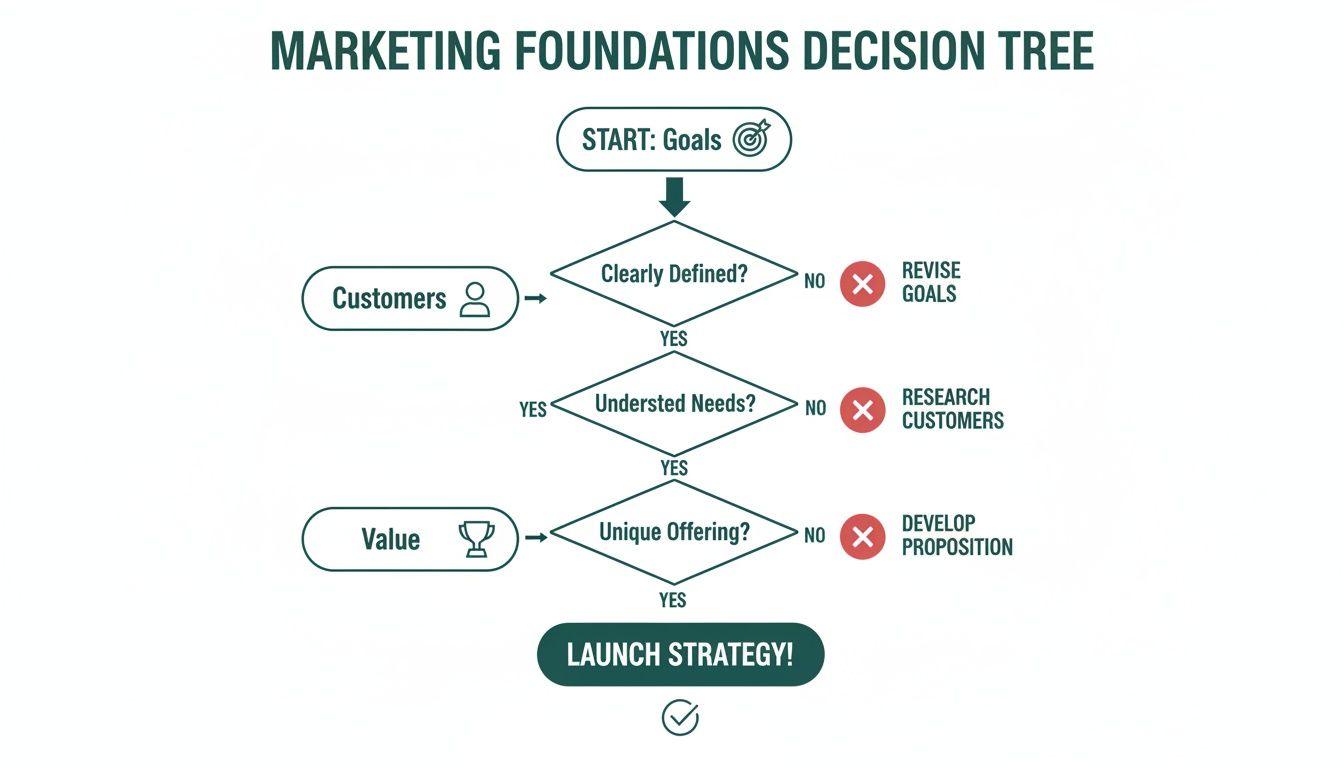
As the flowchart shows, every smart marketing move you make flows directly from knowing what you want to achieve and who you're trying to help.
Pinpointing Your Highest-Impact Channels
Let's dig into the main options. Each platform has its own personality and purpose. The easiest way to narrow things down is to think about your business model.
A local San Diego bakery, for example, is all about the visuals. Instagram is a no-brainer for showcasing beautiful pastries and daily specials. Combine that with a solid Local SEO strategy, and you’ll start showing up when people nearby search for "best croissants near me." That's how you get feet in the door.
On the flip side, a B2B consultant in North County trying to connect with other local businesses would be wasting their time on Instagram. They’ll get much more traction on LinkedIn, sharing industry insights and connecting directly with decision-makers. Email marketing would be a natural next step to nurture those connections.
Your marketing channel selection isn't about what's trendy; it's a strategic choice based on where your audience is most likely to engage and convert. Master one or two channels before expanding.
Comparing Your Core Options
To make a good decision, you need to understand the trade-offs. Some channels give you quick wins but cost more, while others are a long-term play that builds a lasting asset for your business. There's no single "best" channel—only what's best for you right now.
To help you prioritize, here’s a quick comparison of the most common channels for small businesses.
Marketing Channel Selection Matrix for Small Businesses
This table breaks down the essentials for each channel: what it's for, what it'll cost you in time and money, and what kind of business it suits best.
| Channel | Primary Goal | Typical Cost | Time to See Results | Best For |
|---|---|---|---|---|
| Local SEO | Drive organic local traffic & calls | Low (DIY) to Moderate (Agency) | 3-6 Months | Service-area businesses, brick-and-mortar stores, restaurants |
| Social Media | Build community & brand awareness | Low (Organic) to High (Paid) | 1-3 Months | Visual brands, businesses with a strong community aspect |
| Paid Ads (Google/Meta) | Generate immediate leads & sales | Moderate to High | Within a week | E-commerce, lead generation, businesses needing fast results |
| Email Marketing | Nurture leads & retain customers | Low to Moderate | Immediately | Businesses with a repeat customer base, consultants |
| Content Marketing | Build authority & attract traffic | Moderate | 4-6+ Months | Expertise-based businesses, B2B services, complex sales |
As you can see, paid ads on Google or Meta can bring in leads tomorrow, but the traffic disappears the second you stop paying. SEO and content marketing, on the other hand, take patience but can become a source of free, high-quality leads for years to come.
For nearly any local business, the one non-negotiable is Local SEO. It’s how you show up when someone in your area is ready to buy. A great place to start is by learning how to optimize your Google Business Profile to make sure you're capturing those high-intent local searches. Once that’s dialed in, you can start layering on the other channels that make the most sense for your customers and your story.
Adapting Your SEO for an AI-Powered World
The old rules of SEO are getting a major rewrite. For years, the game was simple: climb to the top of Google's search results. But what happens when the search results page starts giving people the answers directly, no click required?
That’s the new reality we’re all navigating. AI isn't some far-off concept anymore; it's standing right between you and your customers, acting as a gatekeeper. This isn't just a minor shift that calls for a few tweaks to your digital marketing strategy. It's a fundamental change that demands a whole new way of thinking about your website's content and how people find you.
The impact has been swift. AI now plays a role in 50-60% of all searches. For a long time, grabbing that coveted #1 spot meant a click-through rate of over 30%. Now, when an AI Overview shows up, that number plummets to just 2.6%. With a staggering 60% of searches now being "zero-click," your content has to be so good that it becomes a source for these AI systems.
Becoming the Go-To Source for AI
In this new environment, your goal has shifted. It’s not just about ranking; it's about making your content "citation-worthy." You need to position your website as the definitive, trustworthy source of information on your specific topic. When an AI like Google’s generates an answer, it pulls from multiple places—your job is to become one of its foundational pillars.
So, how do you actually do that? It all starts with structuring your content to answer questions directly and authoritatively.
Put yourself in your customers' shoes. What questions are they really asking? A local bakery in San Diego, for instance, needs to go deeper than just having a page for "sourdough bread." They should be creating content that tackles specific, real-world queries like:
- What are the health benefits of naturally leavened sourdough?
- How do you store fresh sourdough to keep it from getting hard?
- What's the best feeding schedule for a sourdough starter if you're a home baker?
By crafting detailed, expert answers to these kinds of questions, you turn your site into a valuable resource that AI is far more likely to lean on and cite.
The new currency of SEO is authority and clarity. If your content is the clearest, most helpful answer to a specific question, AI will find and feature it. Your goal is no longer just to rank, but to be the source of the answer itself.
The Overlooked Power of Local SEO and Your Google Business Profile
While becoming a citation source builds broad authority, your most powerful weapon for driving immediate, ready-to-buy local traffic is Local SEO. This is where small businesses can truly shine. AI-powered search leans heavily on location data and proximity to give users the most relevant results, and that’s a huge advantage you can use.
Your Google Business Profile (GBP) is no longer just a simple listing; it's your digital storefront. For many potential customers, it's the first—and sometimes only—interaction they'll have with your business online.
A meticulously optimized GBP sends powerful signals to Google and its AI. Here's what you need to obsess over:
- Complete and Accurate Information: Every single field should be filled out. We’re talking everything from your exact service areas in North County to your precise hours of operation. Consistency across the web is crucial.
- Frequent Updates and Posts: This isn't a "set it and forget it" tool. Regularly add new photos, respond to every review (the good and the bad), and use Google Posts to announce specials or share updates. This activity tells Google you're an active, engaged business.
- Encourage and Manage Reviews: A steady stream of recent, positive reviews is one of the most potent ranking factors in local search. It's the kind of social proof that both customers and AI systems trust implicitly.
When you double down on your local presence, you’re making sure that when someone in your area asks their phone, "Where can I find the best fish tacos in Encinitas?", your business is the one AI confidently recommends. A laser focus on local optimization is a cornerstone of any effective plan to increase organic traffic.
Creating a Content Plan That Actually Converts
Let's be honest. A few random social media posts and the occasional blog article isn't a marketing strategy. It's just noise. A real strategy is built on a deliberate, consistent content plan—one that produces valuable material to pull in your ideal customers, keep them interested, and ultimately, turn them into clients.
The goal here is to stop the panicked, "What should I post today?" scramble. When you have a solid plan, you're always one step ahead. Every single piece of content you create has a purpose, guiding people from being strangers to becoming your biggest fans. You're building a brand story, one helpful article or authentic video at a time.
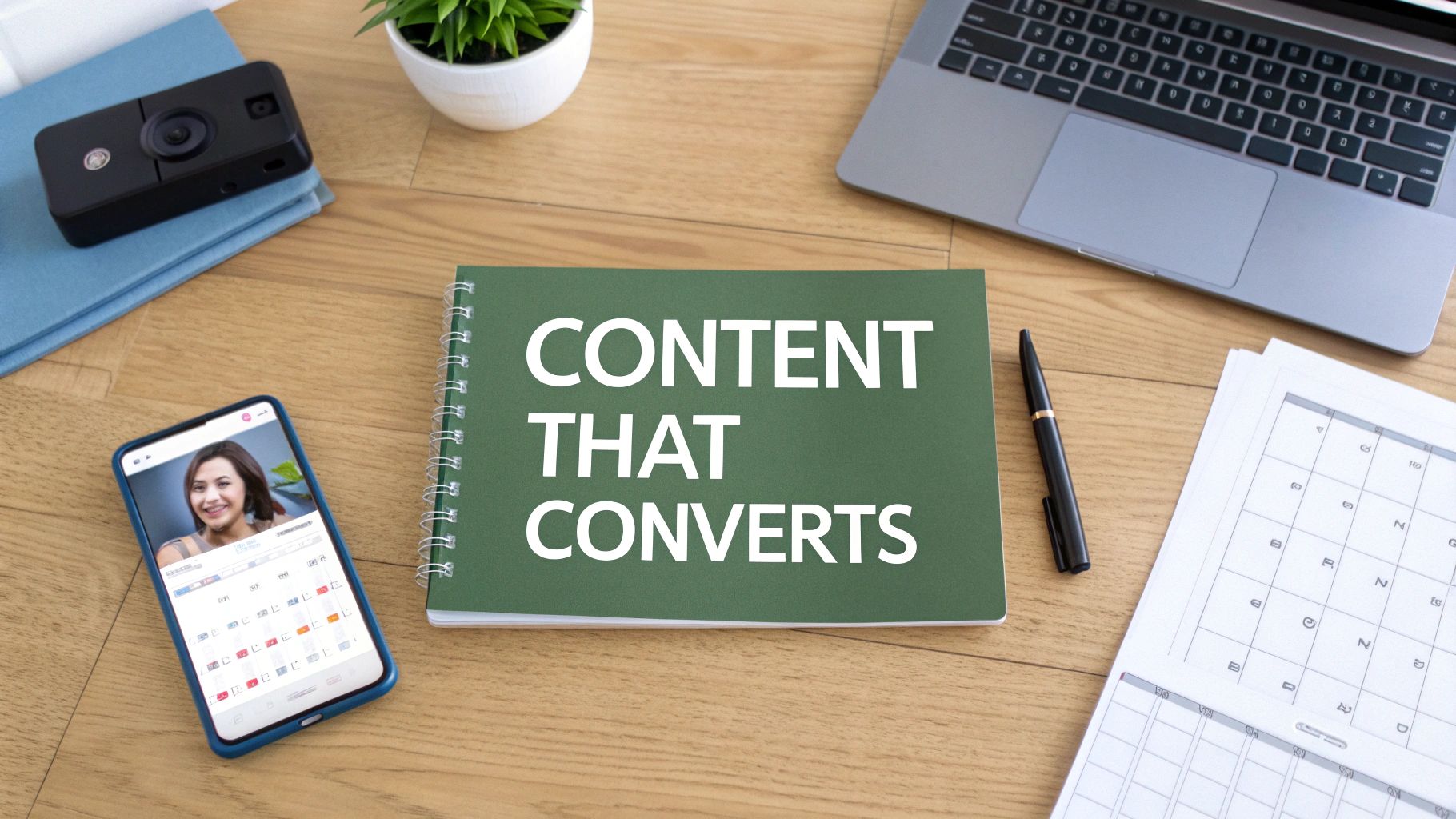
And don't worry, this doesn't have to be some overly complicated, 50-page document. In fact, a simple plan you actually stick with is infinitely better than an ambitious one you ditch by February.
Brainstorming Topics That Matter
Forget guessing what people want to know. Your best content ideas will always come directly from your customers' biggest headaches and most burning questions. Your job is to become the go-to resource in your field by answering those questions better than anyone else.
So, where do you find these golden nuggets of insight?
- Your Inbox and DMs: Look at the top five questions you get asked over and over. Each one is a potential blog post, video, or in-depth guide.
- Competitor Reviews: Go read the 1-star and 3-star reviews for your competitors. The complaints and "I wish it had…" comments are pure gold. They're telling you exactly what the market wants.
- Local Facebook Groups: For a San Diego business, local community groups are a treasure trove. What are people asking for recommendations on? What problems are they trying to solve right now?
Imagine you're a North County-based financial advisor. You might notice people in a Carlsbad moms' group constantly asking about saving for a down payment in such a competitive housing market. Boom. That's a perfect prompt for a blog series, a short video with five quick tips, and a downloadable checklist. This is how you create content that doesn't just rank—it resonates.
Structuring Your Content Calendar
Once you have a list of killer ideas, it's time to get organized. A content calendar is your roadmap. It takes the stress out of content creation by ensuring you have a steady stream of material ready to go across all your channels. It can be a simple spreadsheet or a project management tool like Trello or Asana.
At a minimum, your calendar should track a few key things for each piece of content:
- Topic/Title: The specific subject you're covering.
- Format: Is it a blog post, a short video, an Instagram carousel, or a case study?
- Target Keywords: The main SEO terms you're trying to rank for.
- Publish Date: When it's scheduled to go live.
- Distribution Channels: Where you'll promote it (e.g., email newsletter, LinkedIn, Facebook).
This simple act of planning turns your marketing from a reactive chore into a strategic operation. It lets you see the big picture and make sure you have a healthy mix of content serving different stages of the customer journey.
A content calendar isn't a prison; it's a framework for freedom. It gives you clarity and consistency. The best strategy is one you can actually execute, so start simple and add layers as you go.
Blending Different Content Formats
Would you try to build a house with just a hammer? Of course not. The same goes for your content. Relying on a single format is a surefire way to bore your audience. Different people prefer to consume information in different ways, and certain platforms are built for specific formats.
A great content strategy artfully weaves together various formats to create a richer, more engaging experience.
Think about how you can tell one story in multiple ways. Let's say you have a fantastic customer success story. You could turn that into:
- A Detailed Blog Post: A full case study with quotes, hard data, and compelling before-and-after results.
- An Authentic Video Testimonial: A short, heartfelt video of the client sharing their experience in their own words. Nothing sells like genuine enthusiasm.
- An Instagram Carousel: A visually slick summary with pull quotes and the most impressive results from the case study.
- An Email Newsletter Feature: A teaser of the story shared with your email list, driving traffic back to the full blog post or video.
By repurposing your core ideas, you squeeze every last drop of value out of your efforts and reach a much wider audience. For any small business, this is non-negotiable. It respects your limited time and resources while amplifying your message. It’s all about working smarter, not just harder, to build a content machine that drives real, measurable results.
Using Automation and Email to Maximize Your ROI
As a small business owner, your time is your most valuable asset. Automation isn't about setting up cold, robotic systems; it's about buying back your time so you can focus on the parts of the business only you can do. This is where a smart combination of simple automation and email marketing becomes an absolute game-changer.
Think of it as your best employee—one who works 24/7 without ever needing a coffee break. This digital assistant can greet new leads the moment they show interest, follow up with prospects who are on the fence, and keep your loyal customers in the loop. You set the rules once, and it handles the rest. It's a non-negotiable for any small business owner who needs to make every minute and every dollar work harder.

The goal here isn't just to send emails. It's to build genuine relationships at scale, transforming a fleeting website visit into a lasting connection that brings in repeat business.
Setting Up Simple Automated Email Sequences
The real magic begins with an automated "welcome" sequence. When someone gives you their email address—whether for a newsletter or a free guide—you have a golden opportunity. Don't waste it with a single, generic "thanks!" email.
Instead, build a short series of 3-5 emails that go out automatically over the first week or two. This is your chance to properly introduce your brand, share some of your best stuff, and gently guide them toward what you offer.
Let's imagine you're a local contractor in San Diego. Your welcome sequence could look something like this:
- Email 1 (Immediate): "Here's your Home Renovation Checklist!" A warm welcome that instantly delivers what they asked for.
- Email 2 (2 Days Later): "See what this North County family had to say." Share a quick video testimonial or a case study to build social proof.
- Email 3 (4 Days Later): "Avoid these 5 common kitchen remodel mistakes." Offer pure value with a helpful blog post or tip sheet.
- Email 4 (7 Days Later): "Ready to chat about your project?" End with a soft, no-pressure call to action to book a consultation.
This entire funnel runs on autopilot, making sure every single new lead gets the same professional, trust-building experience.
Your automated welcome sequence is your single best opportunity to turn a casual visitor into an engaged follower. It educates, builds trust, and pre-qualifies leads before you ever have a conversation.
The Undeniable Power of Email Marketing
With all the noise on social media, it’s easy to forget about email. But here's the reality: email marketing is still the undisputed champion for small businesses. Why? Because you're talking directly to people who have asked to hear from you. It's a permission-based channel, and the return on investment is just staggering.
The numbers don't lie. Forecasts for 2026 show that email marketing is expected to deliver an incredible $42 return for every $1 spent. And when AI gets involved, things get even better. Businesses using AI in their email efforts see a success rate of 53%, blowing past the 35% rate for those who don't. That 18-point difference shows just how powerful AI-driven personalization has become. You can dive deeper into these powerful small business marketing statistics on PostcardMania.com.
Writing Emails People Actually Open
Getting your email into someone's inbox is half the battle. The other half is getting them to actually open it. The secret? Stop writing like a faceless corporation and start writing like a human being.
Your subject line is everything. It’s the first impression that determines whether you get a click or get ignored. Ditch the boring, sales-heavy titles.
Instead, spark curiosity, create a little urgency, or get personal. Something like, "A quick question for you, [Name]" or "Your home renovation checklist is inside" will almost always beat a generic subject like "Our Company Newsletter."
Once they're in, keep the email scannable and focused. Use short sentences, break up your text, and have one clear thing you want them to do. A personal sign-off goes a long way, too. These small tweaks make your emails feel less like a mass broadcast and more like a personal note—and that's what builds relationships that last.
Tracking What Actually Grows Your Business
You can have the most creative marketing campaigns in the world, but if you can't tell whether they're actually making you money, you're just guessing. It's easy to get bogged down by "vanity metrics" like website page views or the number of likes on a social media post. Instead, we need to zero in on the numbers that directly impact your revenue.
For a small business, this isn't about building some overwhelming, complex spreadsheet. It's about identifying a few powerful metrics that tell a clear story about your return on investment and signal real, sustainable growth.
Pinpointing Your Key Performance Indicators (KPIs)
Let's start by focusing on the data that connects directly to new customers and their value to your business. We're not tracking every single click; we're trying to understand the real-world outcomes of your marketing.
Here are the essential KPIs I recommend every small business owner keeps a close eye on:
- Qualified Leads: This isn't about every single person who fills out a form. We're talking about the leads who actually fit your ideal customer profile and show genuine interest. Quality over quantity.
- Cost Per Acquisition (CPA): This is the ultimate reality check. How much are you actually spending in marketing dollars to land one new, paying customer?
- Conversion Rate: Of all the people who visit your website, what percentage of them take the action you want them to, like booking a consultation or buying a product?
- Organic Traffic from Target Keywords: Are you showing up in Google for the right searches? Attracting visitors who are actively looking for the solutions you provide is far more valuable than random traffic.
Think of your marketing dashboard this way: it should give you an immediate answer to the question, "Is our marketing making us money?" If a metric doesn't help you answer that, it's probably just noise.
Setting Up a Simple Reporting Rhythm
Once you know what to track, the next step is building a consistent habit of reviewing it. This isn't something you set up once and forget. It’s an ongoing cycle of checking in, learning, and tweaking your approach.
A simple dashboard in a tool like Google Looker Studio can be a game-changer, pulling all the important data from your website and ad campaigns into one clean, easy-to-read view.
Block out a little time each month to look at your performance compared to the goals you set in the beginning. Ask the important questions. Did that new blog series actually drive a spike in qualified leads? Is your ad spend on Meta giving you a lower CPA than your Google Ads?
This is how you start making truly smart decisions. You can confidently double down on the channels that are delivering a real return and pull back from the ones that are just eating up your budget. This is how a good marketing plan evolves into a powerful, predictable engine for growth.
Common Marketing Questions (and Straightforward Answers)
It's totally normal to have a ton of questions when you're trying to figure out marketing. Let's cut through the noise and get you some clear answers to the things small business owners ask me all the time.
How Much Should I Actually Spend on Marketing?
There's no one-size-fits-all answer here, but a good starting point is to put 5-10% of your total revenue toward your marketing efforts. If you're a new business just trying to get your name out there, you might want to bump that up to 12-15% to really gain some momentum.
But honestly, picking a percentage is just a guideline. A much smarter way to do it is to work backward. Figure out how many new customers you actually need to hit your goals, then look at what it typically costs to acquire one. That gives you a budget based on real data, not just a random number.
There Are So Many Options. Where Do I Even Start?
For almost every local business, the answer is Local SEO. Your first move should be to claim and fully deck out your Google Business Profile. This is your digital storefront, and it's how you show up for people in your area who are literally searching for what you do right now. The intent doesn't get any higher than that.
So many business owners make the mistake of trying to be everywhere at once. Don't. Get really good at one or two channels that matter—like your Local SEO and maybe an email list—before you even think about adding another. Being consistent on the right platforms will always beat spreading yourself thin across all of them.
Once you’ve got your local search presence dialed in, think about where your specific customers hang out online. If you run a coffee shop or a boutique, Instagram is probably your next best bet. If you're a B2B consultant, you'll find your people on LinkedIn.
How Long Does This Stuff Take to Work?
This is a big one, and the answer really depends on the channel you're using. The timeline for seeing a return can vary quite a bit.
- Paid Ads (Google/Meta): This is the fast lane. You can see traffic and leads rolling in almost right away, often within the first week.
- Email Marketing: Also very quick. The moment you hit "send" on a campaign, you can start seeing opens, clicks, and sales.
- Local SEO & Content Marketing: These are your long-term plays. Think of them as planting a tree. It usually takes a solid 3-6 months to see a real impact on your rankings and organic traffic.
Patience is an absolute must for organic strategies. Paid ads give you that instant boost, which is great for short-term wins. But it's SEO and content that build a real, lasting asset for your business—one that will keep bringing you free leads for years to come. The best strategies find a way to balance both.
Ready to build a marketing engine that drives real growth, without all the guesswork? Danny Avila blends strategy with top-notch creative to help San Diego businesses look incredible and get found. Start your project today.