
Forget all the complicated jargon for a moment. Think of AI marketing for small business as having a marketing Swiss Army knife that works around the clock. It’s a tool that can analyze data, help draft content, and fine-tune your ad campaigns, giving you the kind of firepower to compete with much bigger companies—without needing their massive budgets.
What Is AI Marketing and Why It Matters Now
At its heart, AI marketing is simply using smart technology to make better, faster decisions based on data. It’s less about robots taking over and more about giving your current marketing a serious upgrade. AI doesn't replace the fundamentals you already rely on, like SEO, ads, or customer emails. Instead, it makes every single one of them work harder and smarter for you.
For example, instead of spending a week guessing which ad headline will resonate with your audience, an AI tool can test hundreds of options in minutes and tell you the clear winner. Or, rather than manually responding to every new Google review, AI can draft thoughtful, personalized replies that you just need to approve and post. It’s all about getting the tedious, time-consuming tasks off your plate so you can focus on the big picture.

Leveling The Competitive Playing Field
For a long time, large corporations had a huge advantage. They could afford big teams of analysts and marketers to crunch numbers and run complex campaigns. AI completely changes that game. It puts the same kind of powerful data analysis and automation right at your fingertips, letting you make smarter decisions, faster.
This isn't just another passing trend; it's a fundamental shift in how small businesses can grow. We’ve moved past the experimental phase. In fact, a recent LinkedIn report found that a striking 57% of small business owners believe AI will significantly improve their daily work lives. That tells you we're well into the adoption stage.
The Core Benefits For Your Business
When you start weaving AI into your marketing, you’re doing more than just saving a few hours. You're building a more efficient, resilient, and competitive business. This technology helps you connect with customers in more meaningful ways, get more out of every dollar you spend, and free yourself up to do what you do best—run your company. It's a key difference to consider when weighing digital marketing vs. traditional marketing.
To put it simply, here’s how AI can directly impact your business, moving you from guesswork to data-driven confidence.
Core Benefits of AI Marketing for Small Businesses
| Benefit Area | How AI Delivers | Example Application |
|---|---|---|
| Deeper Customer Insights | Analyzes customer behavior, social media chatter, and sales data to spot patterns and trends that would otherwise be impossible to see. | Identifying that your most profitable customers consistently buy a specific product combo, allowing you to create a targeted bundle offer. |
| Enhanced Personalization | Delivers customized messages, product recommendations, and offers to individuals at a scale that's impossible to do manually. | An e-commerce store using AI to show returning visitors products related to their last purchase, instantly making the shopping experience more relevant. |
| Increased Efficiency | Automates repetitive but essential tasks like sending email sequences, scheduling social media posts, and pulling performance reports. | An AI tool that automatically generates a weekly report of your top-performing blog posts and ad campaigns, saving you hours of manual data compilation every Monday morning. |
| Competitive Advantage | Provides access to sophisticated analytics and optimization strategies previously only available to large enterprises with big budgets. | A local San Diego plumber using AI-powered bidding on Google Ads to outrank larger regional competitors for high-value keywords like "emergency plumbing," all while staying within budget. |
These benefits aren't just theoretical; they translate into real-world results that give small businesses a fighting chance to not just compete, but to lead in their local markets.
The real power of AI marketing isn't just about speed. It's about precision. It’s about letting real data, not a hunch, guide your decisions. This shifts your whole strategy from simply reacting to the market to proactively shaping your customer's journey.
Practical AI Strategies for Local Marketing Growth
Alright, let's move from theory to action. For a small business, this all comes down to one thing: driving local growth. You don't need to reinvent your entire marketing plan overnight. The key is to weave smart, accessible AI tactics into what you're already doing, making those efforts exponentially more effective.
Think of AI as a powerful assistant for your local presence. It can take over the tedious, time-consuming tasks that eat up your day, freeing you up to focus on what really matters—building customer relationships and steering the ship. The goal is to plug in proven AI applications that give you a clear return, right now.
And small businesses are catching on fast. Recent reports show that a staggering 89% now use AI tools for everyday work like writing emails, creating content, or crunching data. This completely changes the game, allowing small shops to punch well above their weight and achieve big-business results without the big-business budget. You can see more data in this detailed report on AI in sales and marketing.
Dominate Local SEO with AI
Your Google Business Profile (GBP) is your digital front door. AI is the perfect tool to keep it looking sharp. We all know responding to reviews is crucial for local rankings, but who has the time? AI tools can generate thoughtful, personalized draft responses in seconds, matching the tone of the original review. This makes maintaining a 100% response rate totally manageable.
You can also use AI to fill out your GBP Q&A section. Just feed it your service details and frequently asked questions, and it will churn out clear, keyword-optimized answers that get ahead of what local customers are searching for. It's a simple, proactive way to control your message right on the search results page. For a deeper dive, check out our guide on how to optimize your Google Business Profile.
This graphic really drives home how AI has become a go-to for so many marketing and sales tasks.
As you can see, lead generation and content creation are at the top of the list, proving that AI’s real strength is speeding up the core activities that actually grow a business.
Launch Hyper-Targeted Ad Campaigns
Modern ad platforms like Meta and Google Ads have incredible AI built right in. Forget spending hours creating dozens of ad versions by hand. Now, you can give the AI a handful of headlines, descriptions, and images, and it will automatically test countless combinations to find the winners for different types of customers.
This is where AI marketing for small business becomes a game-changer. It removes so much of the guesswork.
Imagine a local cafe in San Diego. Instead of running separate campaigns for "coffee lovers," "remote workers," and "study groups," they can just let the AI create and test variations for each. The system automatically shifts the ad spend to the audiences that are actually booking tables or buying coffee, driving down costs and boosting the return on every dollar spent.
Accelerate Your Content Creation
Good content is the fuel for modern marketing, but it's a beast to feed consistently. AI can be your new creative partner, helping you smash through writer's block and build out a content schedule that works. Use it to brainstorm blog topics your local customers care about, draft snappy social media posts, or outline scripts for short videos on Instagram Reels or TikTok.
For instance, a real estate agent in North County could ask an AI to:
- Generate five blog titles about the "Best Family-Friendly Neighborhoods in Encinitas."
- Write a short video script highlighting the top three features of a new Carlsbad listing.
- Create a week's worth of Instagram posts featuring local events and market updates.
The AI gives you a solid first draft in moments. From there, you just need to polish it with your own expertise and brand voice. This process can easily cut your content production time in half, helping you stay visible, build authority, and attract new clients without burning out.
Choosing Your First AI Marketing Tools
Diving into AI marketing for small business can feel like walking into a massive hardware store for the first time. The options are overwhelming, and every shiny new tool claims it will change your life.
But here’s the secret: you don't need a massive, expensive toolkit to see a real difference. The trick is to start small and zero in on solving one specific problem.
Instead of trying to boil the ocean, figure out your single biggest marketing headache right now. Are you burning hours writing social media posts? Struggling to get customer reviews? Is your website invisible in local searches? Your answer points you directly to the first tool you should try. This focused approach ensures you feel the impact—and see a return on your investment—right away.
Start with Your Biggest Bottleneck
The shift toward AI is already happening. A recent study found that 55% of small business owners are using AI, with the top reason being to create more personalized experiences that boost engagement and sales. This insight, highlighted in recent small business marketing trends on wix.com, shows that owners are leaning on AI for a creative spark and to win back valuable time.
This data really hammers home the 'start simple' idea. If content creation is your personal grind, a writing assistant is your best first step. If your ads are underperforming, an optimization tool is where you should look.
This chart shows exactly where small business owners are putting AI to work.
As you can see, marketing and sales are the top priorities for AI adoption, beating out administrative or customer service tasks by a wide margin.
Categorizing Your Options
To help narrow down your search, let's group the tools by what they actually do. Most AI platforms fall into one of these buckets, and many offer free or cheap starting plans that are perfect for small businesses just getting their feet wet.
Content Creation: Think of these as your creative sidekick. They can help draft blog posts, social media updates, email newsletters, and even video scripts. ChatGPT is the most well-known, and its free version is incredibly powerful for getting started.
SEO & Analysis: These platforms help you figure out what your customers are searching for online and how you can show up higher on Google. Tools like SurferSEO can analyze what’s already ranking and give you a data-backed roadmap to create better content.
Ad Management: Don’t overlook the AI that’s already built into platforms like Google Ads and Meta Ads. It’s surprisingly smart, automatically testing different ad versions, finding the right audiences, and tweaking your budget to get you more leads for less money.
Automation: This is where you put repetitive tasks on autopilot. These tools can send follow-up emails to new leads, schedule an entire month of social media posts, or manage customer inquiries. Many email marketing platforms now bake AI automation right into their core features.
A classic rookie mistake is paying for a huge, all-in-one platform before you actually need it. Start with a free or low-cost tool that solves one nagging problem. Once you've mastered it and can point to a clear ROI, then it’s time to explore bigger solutions.
You can also see how this technology is shaking up other areas, like with these AI-powered web design tools for 2024.
AI Tool Comparison for Key Marketing Tasks
To make things even simpler, here’s a quick-glance table comparing some popular AI tools. This should help you match a tool to a task and get a sense of the investment required.
| Marketing Task | Example Tool | Best For | Cost Level |
|---|---|---|---|
| Content Creation | ChatGPT | Small businesses needing quick drafts for blogs, social media posts, and emails to overcome writer's block. | Freemium |
| Local SEO | SurferSEO | Service-based businesses in competitive local markets who want to outrank competitors with data-driven content. | Paid |
| Ad Management | Google Ads AI | Businesses running paid search campaigns that need to maximize their ad spend and automate bid strategies effectively. | Included in Ad Spend |
| Marketing Automation | HubSpot | Companies ready to scale their lead nurturing with automated email sequences and customer relationship management. | Freemium |
Choosing your first AI tool is about making a smart, strategic decision that saves you time and makes you money. Start with one, get a win, and build from there.
Your Four-Step AI Marketing Implementation Roadmap
Jumping into AI marketing doesn't mean you have to take a huge, blind leap. Honestly, that's the worst way to do it. The smart approach is a clear, practical plan. Trying to boil the ocean and do everything at once is a classic recipe for getting overwhelmed and giving up. Instead, a step-by-step process lets you make real progress, learn as you go, and see results without getting lost in the tech.
Think of this roadmap as building a house: you pour a solid foundation long before you start worrying about paint colors. This methodical approach stops you from wasting time and money, ensuring every tool you bring in serves a specific, measurable purpose for your business.
Stage 1: Discover Your Biggest Opportunities
Before you even glance at a single AI tool, you need to figure out where it’s going to make the biggest difference. This discovery phase is all about taking a hard look at your current marketing to find the bottlenecks, the time-sucks, and the areas with the most untapped potential. It all comes down to asking the right questions.
Start by mapping out your most time-consuming weekly chores.
- Are you spending hours every week just responding to Google reviews?
- Does creating social media content feel like a constant, uphill battle?
- Is your team drowning in data, trying to guess which leads are actually worth a follow-up call?
Your answers are your treasure map. They'll point you to a shortlist of high-priority problems. If writing blog posts chews up ten hours a week, an AI content assistant is an obvious win. If qualifying leads is a massive headache, an automated scoring tool should be your first stop. This audit gives you a clear target, guaranteeing your first step into AI solves a real, painful problem.
Stage 2: Build Your Foundation
With a specific problem in mind, you can start building your solution. This is where you pick the right tool for the job and get your team and workflow ready for it. The key here is to start small. Don't get lured into a massive, all-in-one platform when a simple, maybe even free, tool can get the job done.
This simple flowchart shows exactly how to think about choosing your first AI tool, moving logically from a problem to a tested solution.
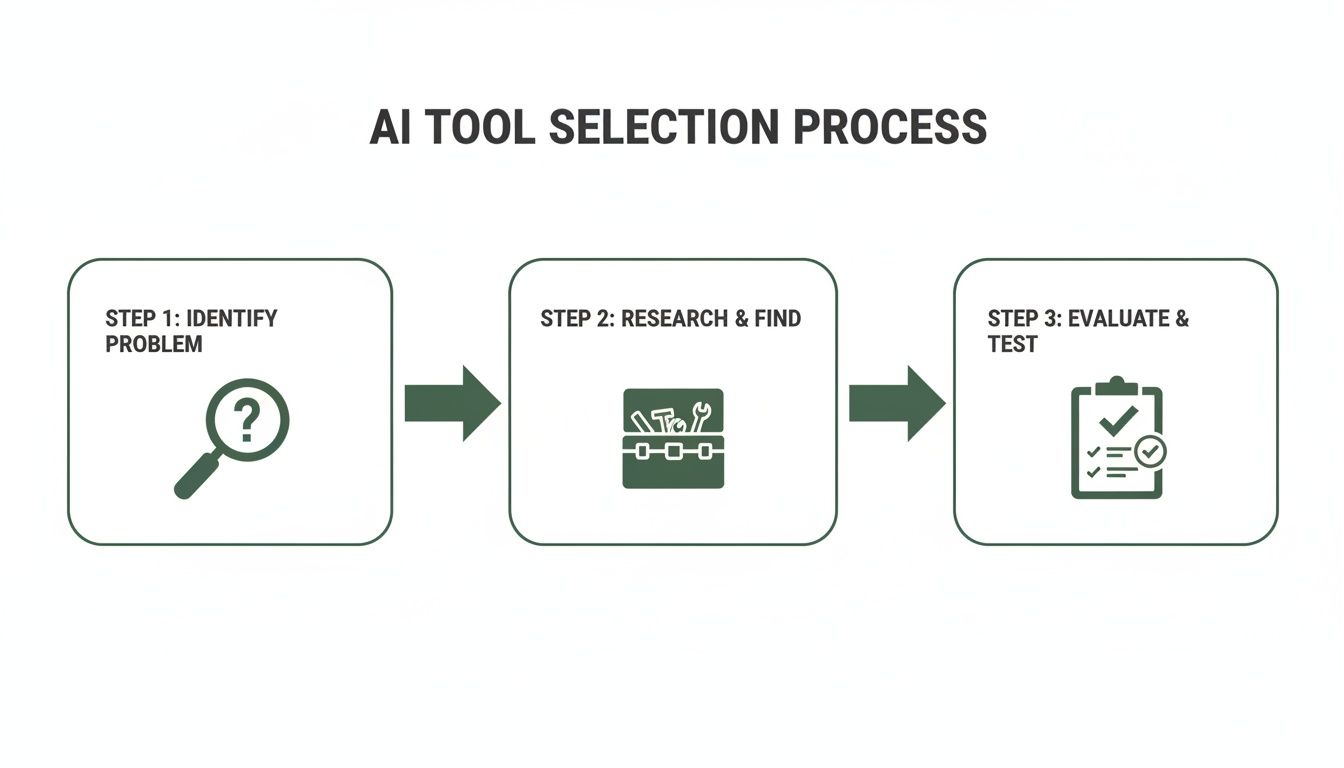
As the visual shows, it’s not about finding the "best" tool on the market—it’s about finding the right tool for your specific business challenge.
Once you’ve picked a tool—let's say you're trying ChatGPT to help generate social media posts—the next step is prepping your workflow. Create a simple guide for your team. Define your brand voice, write out a few example prompts, and set up a quick review process. This prep work ensures consistency and helps everyone get comfortable with the new way of doing things before you go live.
Stage 3: Launch Your First Campaign
Okay, time to put your new tool to work. The launch is all about rolling out your first AI-assisted project in a controlled, measurable way. This isn't a "rip and replace" of your entire strategy. It’s about running one focused project to test the waters and prove the concept works.
A great place to start is with a small, low-risk project. For example, use your new AI tool to generate one week's worth of Instagram posts. Run them alongside your usual, manually created content and compare the engagement. You've just created a simple, direct A/B test.
This gives you clean data on what’s working. You might discover the AI-generated posts get 20% more shares but need a little more editing to nail your brand's unique voice. That kind of specific, actionable insight is gold. Remember, the goal of your first launch is learning, not perfection.
Stage 4: Grow and Scale Your Efforts
With a successful first launch in the bag, you’re ready for the final stage: growth. This isn't a one-and-done step; it's a continuous cycle of monitoring, analyzing, and expanding how you use AI. It's where you take the lessons from your initial test and start applying them to other parts of your marketing.
First, set up a simple dashboard to track the key performance indicators (KPIs) from your first project.
- Monitor Key Metrics: Keep a close eye on things like time saved, cost per lead, and content engagement.
- Analyze the Results: Look for patterns. Did AI help you post more frequently? Did it slash the time you spend creating content?
- Find the Next Opportunity: Based on that success, go back to your discovery list and pick the next bottleneck to solve.
If your AI-powered social media test was a hit, maybe the next step is using AI to automate your email follow-up sequences. Or perhaps you can use it to start optimizing your Google Ads copy. By taking this methodical "rinse and repeat" approach, you can strategically scale AI across your business, building a more efficient and powerful marketing engine one piece at a time.
Measuring the ROI of Your AI Marketing
Bringing new AI tools into your marketing is exciting, but let's be real—the only thing that matters is whether they actually make you money. To justify spending your hard-earned cash and time, you have to connect the dots between the technology and your bottom line.
This means looking past the "vanity metrics" like a few extra likes on social media. We're talking about measuring the numbers that directly signal real business growth. Proving the return on investment (ROI) isn't about becoming a data scientist overnight. It’s about knowing which numbers to watch to see if AI is making your marketing smarter, leaner, and more profitable.
Key Metrics That Truly Matter
To get a true read on how your AI marketing for small business is performing, you need to zero in on the metrics that are tied directly to revenue and efficiency. These are the numbers that tell you if your strategy is actually moving the needle.
Here are the essential KPIs you should be watching:
- Cost Per Lead (CPL): Simply put, how much does it cost you to get one new lead? If your AI-powered ads are bringing in more leads without you spending more, your CPL will drop. That’s a crystal-clear sign of a positive return.
- Customer Acquisition Cost (CAC): This one takes it a step further. CAC tells you the total cost to bring a new paying customer through the door. AI can drive this number down by helping you find and convert the right people, so you spend less to win each sale.
- Organic Traffic Growth: When you use AI to boost your SEO, a steady climb in website visitors from Google is a huge win. It's direct proof that your AI-assisted content is hitting the mark and pulling in your ideal audience.
- Conversion Rate: What percentage of people who visit your site or see your offer actually take action? Whether it’s filling out a form or buying a product, AI-driven personalization and testing can give this number a serious lift.
Tracking these KPIs gives you a no-nonsense picture of how AI is impacting your business's financial health, making it easy to see why it's worth the investment.
Proving Effectiveness with Simple Tests
One of the easiest ways to see what's working is to put AI head-to-head with your old methods. Running a simple A/B test—where you pit an AI-generated ad or email against a human-written one—gives you undeniable proof of what performs better.
For example, a real estate agent in San Diego could run two Facebook ads with the same budget and audience. One ad uses copy they wrote themselves, and the other uses copy generated by an AI tool. After a few days, they can see which one generated more clicks and inquiries. The data tells the real story, no guesswork involved.
This straightforward approach works for just about anything: email subject lines, blog post titles, landing page headlines, and ad copy.
Building Your Simple ROI Dashboard
You don’t need a complicated software suite to keep track of your results. A basic spreadsheet is all it takes to build an ROI dashboard and see your progress at a glance.
Here’s a simple template to get you started:
| Metric | Week 1 (Before AI) | Week 2 (With AI) | Week 3 (With AI) | % Change |
|---|---|---|---|---|
| Cost Per Lead (CPL) | $50 | $42 | $38 | -24% |
| Organic Traffic | 1,200 | 1,350 | 1,510 | +25% |
| New Customers | 10 | 14 | 17 | +70% |
A simple dashboard like this makes the impact of your AI marketing impossible to ignore. It visually connects your efforts to real-world results, making it easy to see what’s working and share the wins with your team. By consistently tracking these numbers, you turn AI from a hopeful experiment into a reliable engine for growth.
Answering Your Top Questions About AI Marketing
Even with a clear plan, diving into AI marketing can feel a little daunting. It's totally normal to have a few questions swirling around before you jump in with both feet. Let's tackle some of the most common concerns I hear from business owners to help clear things up.
The idea here isn't to sell you on some far-off, futuristic dream. It's about giving you practical, straight-up answers so you can move forward with confidence. Think of this as our final huddle before you start the engine.
Is AI Marketing Too Expensive for a Small Business?
Absolutely not. This is probably the biggest myth holding local business owners back. Many of the best AI marketing for small business tools were built specifically for tight budgets, often offering free plans or very affordable starting tiers.
The trick is to avoid boiling the ocean. Don't try to do everything at once.
- Pinpoint your single biggest time-waster. Is it drafting social media posts? Responding to reviews?
- Find one tool that solves that specific problem.
- Start with a free trial or the most basic paid plan.
Honestly, the time you get back and the efficiency you gain will almost always pay for that small investment right away. You don't need a massive budget—you just need a sharp focus.
Will AI Replace My Marketing Team (or Me)?
Think of AI as a powerful teammate, not a replacement. I love what one expert recently said: your job won't be taken by AI, but by someone who knows how to use AI. That hits the nail on the head. AI is brilliant at handling the repetitive, data-crunching tasks that bog us down.
That frees you and your team up for the stuff that truly matters: big-picture strategy, genuine customer connection, and creative thinking.
For instance, AI can spit out a first draft of a blog post in minutes. But it takes a human touch to weave in your brand's unique voice, share a personal story, and make sure it truly resonates with your San Diego customers. It’s a partnership, not a pink slip.
How Do I Start If I'm Not Tech-Savvy?
Here's the best part: you don't need to be a coding genius. Most modern AI marketing platforms are designed to be incredibly user-friendly. If you can use Facebook, you can use these tools. They have simple, intuitive interfaces that are all about clicking, typing, and getting results.
The perfect first step? Just play around with it.
Open up a tool like ChatGPT and give it a simple command. Try something like: "Write three Facebook post ideas for a local North County coffee shop celebrating a new seasonal drink."
This kind of hands-on, low-stakes experimenting is the fastest way to see the magic for yourself. It pulls back the curtain on the technology, shows you just how approachable it is, and helps you get past any technical jitters.
Ready to stop guessing and start growing with a clear, AI-powered strategy? At Danny Avila, we blend practical AI solutions with creative video, web design, and SEO to build a complete marketing engine for your San Diego business. Book your discovery call today and let’s map out your path to real, measurable growth.