
Trying to do content marketing without a plan is a bit like driving in a new city without a map. You might eventually get somewhere, but you'll waste a lot of time and gas getting there. For a local business, that means churning out blog posts and videos that never quite hit the mark with actual customers.
The fix? Start with a solid foundation. You need to audit what you’ve got, figure out who you're really talking to, and set clear goals before you create a single piece of content.
Build a Content Foundation That Actually Works
Too many local businesses jump straight into content creation, throwing things at the wall to see what sticks. A much smarter approach is to step back and lay the groundwork first. This simple shift prevents you from creating content that’s totally disconnected from what you actually want to achieve, whether that's more foot traffic, more phone calls, or more qualified local leads.
The process is logical: take stock of where you are now, get laser-focused on your ideal local customer, and then set goals you can actually measure.
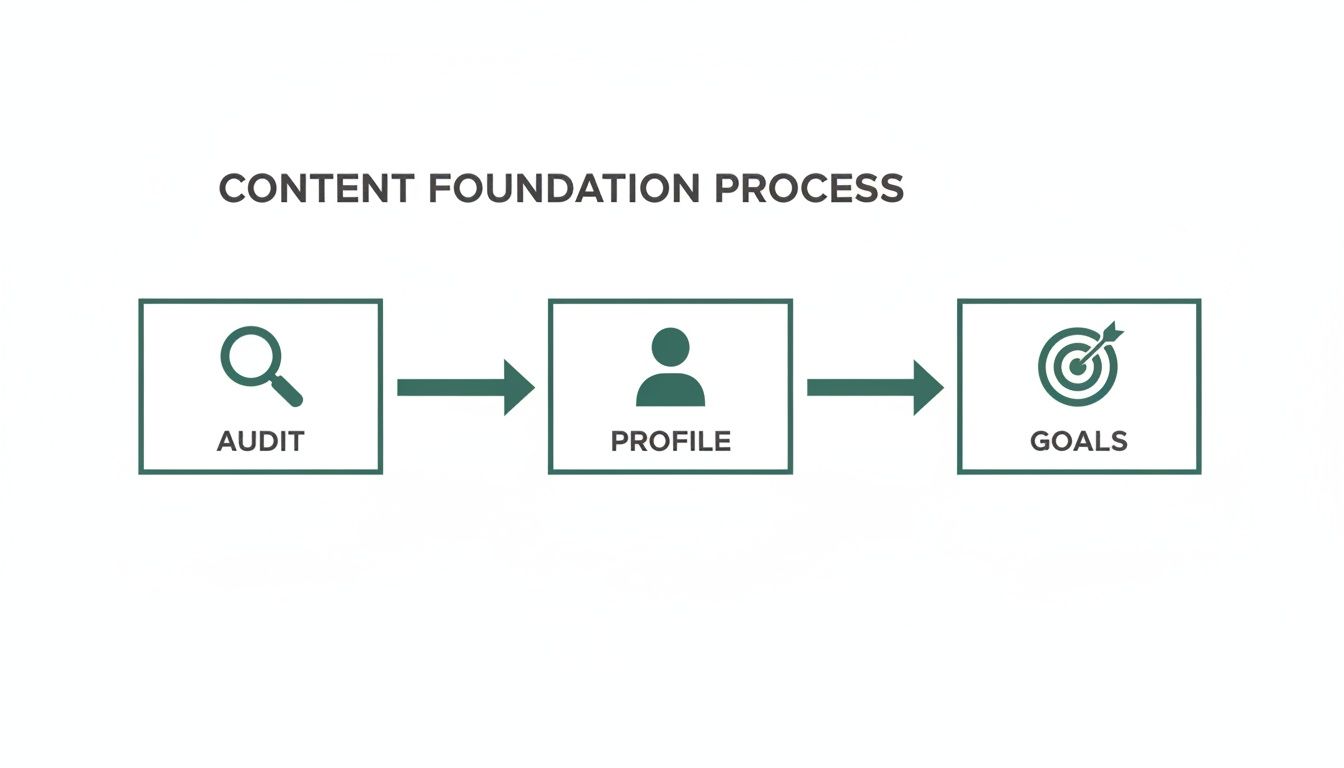
This sequence—Audit, Profile, and Goals—is your insurance policy. It ensures that every blog post, video, or social media update you publish has a clear purpose tied directly to growing your business.
Audit Your Existing Online Footprint
Before you dream up new ideas, you have to know what's already out there. A quick content audit gives you a baseline, showing you what’s working and what’s collecting dust. You don't need fancy, expensive tools for this initial pass.
Start with what you can see easily. Look at your most engaging social media posts. Which ones got the most comments, shares, or messages? Those are breadcrumbs left by your audience, telling you exactly what they care about.
Next, poke around in your website analytics. Which pages or posts are getting the most visits? Even if the numbers are small, you can spot themes that resonate. And don't forget your Google Business Profile insights. It’s a goldmine. See which photos get the most views or what search terms people used to find your listing. This is raw data on local customer intent, free for the taking.
Define Your Ideal Local Customer
Forget the generic "Marketing Mary, age 35-45" personas. They're useless for a local business. You need to get real and think about the actual people living in your service area. What specific problems are they dealing with that you can solve?
Let's say you're a plumber in San Diego. Your target isn't just "homeowners." It's people like:
- "Coastal Chris" in La Jolla, who owns an older home and is constantly worried about salt air causing pipe corrosion.
- "North Park Natalie," who just bought a charming but old house and is freaked out about what’s lurking in the pre-war plumbing system.
When you get this specific, your content can speak directly to their real-world anxieties and search queries. You’re no longer just a plumber; you're the go-to expert for their unique, local plumbing headaches. Truly understanding these nuances is critical if you want to learn how to increase organic traffic in a crowded local market.
Key Takeaway: The goal isn’t to describe a person. It’s to understand a local problem so you can create content that offers the solution. This is the core of effective content marketing for local businesses.
Set S.M.A.R.T. Content Goals
Finally, you have to turn vague wishes like "get more customers" into concrete, measurable goals. This is where the S.M.A.R.T. framework (Specific, Measurable, Achievable, Relevant, Time-bound) comes in handy. It's a classic for a reason.
Instead of "more leads," get Specific: "Increase phone call leads generated from our website."
Now make it Measurable: "Increase phone call leads by 20%."
Is that Achievable? Look at your current traffic and resources. If a 20% jump is realistic, great. If not, adjust.
Make sure it's Relevant. Does this goal actually help your bottom line? Absolutely. More calls mean more jobs booked.
Finally, make it Time-bound: "Increase phone call leads by 20% over the next quarter."
The table below breaks down how to connect your broader business objectives to tangible content marketing actions and metrics.
Translating Business Goals into Content Marketing Actions
| Business Objective | Content Marketing Goal | Primary Content Channel | Key KPI to Track |
|---|---|---|---|
| Increase Foot Traffic | Drive more in-store visits from local search | Google Business Profile Posts | "Get Directions" Clicks |
| Generate More Leads | Increase qualified inbound phone calls | Website Service Pages | Form Submissions, Click-to-Call Events |
| Build Local Authority | Become the go-to expert in the community | Blog & Local Guides | Organic Keyword Rankings for "near me" terms |
| Boost Customer Loyalty | Encourage repeat business from existing clients | Email Newsletter, Social Media | Repeat Customer Rate, Coupon Redemptions |
By aligning your efforts this way, you ensure every piece of content serves a strategic purpose.
With this solid foundation in place, you’re ready to move forward. Every piece of content you create will now have a clear purpose, a specific audience, and a way to measure its impact on your business. No more guessing.
Uncover the Keywords Your Neighbors Are Using

If you want your local content marketing to actually work, you first have to figure out the exact words and phrases your customers are typing into Google. It's about getting inside their heads and understanding what they search for when they have a problem you can solve. This goes way beyond just sticking your city's name on the end of a service—it’s about digging into local intent.
Think about it like this: when a pipe bursts under someone's sink, they aren't casually searching for "plumbing services." They're frantically typing things like "emergency plumber near me" or "24-hour plumber in North Park." Your job is to find these high-intent, location-specific phrases that scream "I need help now!"
Moving Beyond Basic Keyword Modifiers
The obvious starting point is brainstorming "service + location" keywords, and that's a solid foundation. But it’s really just the beginning. To truly connect with your local audience, you need to expand your thinking and capture the full spectrum of how people search.
Here are the main types of local keywords to hunt for:
- Geographic Qualifiers: This is the most direct approach. Think "San Diego roofer," "electrician in Encinitas," or "HVAC repair 92104."
- Neighborhood-Specific Terms: People often search at a hyper-local level, mentioning specific neighborhoods, districts, or even landmarks. "Best coffee shop near Balboa Park" is a world away from a generic city-wide search.
- "Near Me" Searches: This is huge. These types of searches have seen over 500% growth in recent years. When someone searches for "restaurants near me," Google uses their device's location to serve up the most relevant results.
Nailing these variations means your content marketing for local businesses will show up at the exact moment a potential customer needs you.
Practical Tools for Local Keyword Discovery
You don't need a massive budget to find these golden keyword nuggets. In fact, some of the most powerful insights come from free and easily accessible tools and platforms.
A fantastic place to start is right on the Google search page. Just start typing a query and watch the Autocomplete suggestions that pop up. These are real searches people are making right now. For example, typing "landscaper in San Diego…" might reveal "…for small yards," "…drought tolerant," or "…affordable." Google is literally handing you content ideas on a silver platter.
Pro Tip: While you're on the results page, scroll down. The "People Also Ask" and "Related Searches" sections are goldmines for finding long-tail question keywords. These are perfect for building out blog posts and FAQ pages that answer real customer questions.
You should also become a digital detective in local online communities.
- Reddit: Find your city's subreddit (like r/sandiego) and look for threads where people ask for recommendations related to what you do.
- Nextdoor: This entire platform is built around neighborhood chatter. Pay attention to the problems people are trying to solve.
- Facebook Groups: Local community and parent groups are constantly buzzing with requests for service providers.
Monitoring these channels lets you tap directly into the voice of your local customer. To make this even easier, you can check out some of the top free SEO tools you should use now to help organize your research.
Putting Local Keywords into Action
Okay, so you've got a solid list of local keywords. Now what? The goal is to weave them into your content naturally, not to stuff them into every other sentence. Use these keywords as inspiration to create genuinely helpful articles, posts, and pages that answer specific local questions.
For instance, if you uncover a keyword like "best brunch spot with a patio in North Park," don't just target the phrase. Use it to create a blog post titled "Our Favorite Sunny Brunch Patios in North Park." This approach directly matches the searcher's intent, gives them real value, and positions your business as the go-to local expert. That's how you drive both traffic and trust.
Create Local Content That Genuinely Connects
You’ve done the keyword research, and now you have a roadmap. It’s time to stop thinking like a marketer and start thinking like a neighbor. This is where you create content that speaks directly to the people in your community and solves their very specific problems.
So many local businesses miss the mark here. They publish generic, cookie-cutter articles that feel like they could have been written by anyone, for anywhere.
To really win at local content, you need to be authentic and hyper-relevant. It's about moving beyond the basic "plumber in Austin" blog posts and tapping into formats that build real trust, show off your expertise, and grab the attention of people just down the street.
Go Beyond Generic Blog Posts
Don't let anyone tell you blogging is dead—it’s an absolute powerhouse for local SEO. We've seen that small businesses who blog consistently get 55% more website traffic than those who don't. It makes sense, right? A great blog post answers a potential customer’s exact question at the very moment they’re searching.
In fact, with 69% of consumers preferring text over other formats for learning about a company, it's still one of the best ways to get discovered. You can dive deeper into these small business marketing stats to see the full picture.
The real magic, though, is in the local angle. Instead of a generic "5 Tips for a Green Lawn," a San Diego landscaper should be writing "5 Drought-Tolerant Plants That Thrive in North County Summers." See the difference?
Here’s how to frame your ideas with that local spin:
- Solve a Hyper-Local Problem: Think about the issues unique to your town. A roofer in Miami would write about hurricane prep; one in Denver would focus on surviving hail season.
- Highlight Community Events: Sponsoring the local little league team? Write a post celebrating their season. Got a booth at the upcoming street fair? Create a quick guide to the event and give your spot a shout-out.
- Create Neighborhood Guides: A real estate agent could build a whole series on "The Best Dog Parks in La Jolla" or "A Foodie's Guide to Little Italy." This positions you as the go-to local expert, not just another salesperson.
Leverage Authentic Local Video
Video is your secret weapon for building a human connection. People buy from people they know, like, and trust. For a local service business, simply showing the real faces behind the company is a game-changer.
Forget the Hollywood production budget. Honestly, overly polished and corporate videos can feel stiff and unrelatable. Your smartphone is all you need to get started.
Try these simple, high-impact video ideas:
- Behind-the-Scenes Tours: Give a quick tour of your workshop, introduce your crew, or walk people through your process. A local coffee shop could film a 60-second clip on how they pull the perfect espresso shot.
- Customer Testimonials: After finishing a job, ask a happy customer (with their permission, of course) if they’d say a few words on camera. A genuine, unscripted "they did a great job" is pure gold.
- Quick Tip Videos: Shoot short, vertical videos for Instagram Reels or YouTube Shorts. An auto mechanic could film a 30-second clip on "How to Check Your Tire Pressure Before a Road Trip."
Key Insight: The goal isn't to go viral across the globe. It's to build trust with the few hundred or thousand potential customers in your service area. When it comes to local video, authenticity beats production value every single time.
Master Your Google Business Profile Posts
Your Google Business Profile (GBP) is your digital storefront. For many customers, it's the very first interaction they'll have with your brand. The "Posts" feature is one of the most powerful—and most overlooked—tools in your local marketing kit. Think of it as a free billboard right on the Google search results page.
GBP Posts are perfect for timely, action-oriented content. They show up front and center when someone searches for your business, but they also expire, which makes them ideal for current events and offers.
Use them to share:
- Special Offers and Promotions: "Get 15% off all plumbing services this week only!"
- New Product or Service Announcements: "Big news! We now offer pet-friendly carpet cleaning."
- Event Updates: "Join us for our holiday open house this Saturday from 10 AM to 2 PM."
- Recent Project Highlights: Post a great photo of that kitchen remodel you just finished, along with a quick description of the work.
Don't forget to add a clear call-to-action (CTA) button like "Call Now," "Learn More," or "Book Online" to every post. This makes it incredibly easy for a customer to go from seeing your post to picking up the phone, driving real business directly from the search page. Plus, a steady stream of posts signals to Google that your business is active and engaged—and that’s always a good thing.
Fine-Tune Your Website and Local SEO Signals
Creating incredible, locally-focused content is a huge step, but it’s only half the battle. If your website isn't technically sound, that amazing blog post or video might as well be invisible. This is where you connect your content engine to your conversion machine—your website.
Think of your site as the central hub for every piece of content you produce. Getting the technical local SEO right ensures that when someone down the street searches for a solution you offer, Google knows to point them directly to you. It's all about sending the right signals to prove you're the real deal, right here in town.
Build Hyper-Local Service and Location Pages
Your website structure needs to scream "local" to both users and search engines. The most effective way I've seen to do this is by creating dedicated pages for each core service and, if you serve multiple areas, for each key location. This is absolutely non-negotiable.
Don't just lump everything onto a generic "Services" page. A plumber in San Diego, for example, should have separate, detailed pages for "Drain Cleaning," "Water Heater Repair," and "Emergency Plumbing." This simple move allows you to target the specific, high-intent keywords that actual customers are typing into Google.
Now, take it a step further with location-specific pages. If that same plumber serves different neighborhoods, they could have pages like:
- Emergency Plumbing Services in North Park: This page could feature content tailored to North Park residents, maybe mentioning local landmarks or the common plumbing issues found in the area's older homes.
- Water Heater Repair in La Jolla: Here, you could discuss specific solutions for homes near the coast, where salty air can affect appliances differently.
These pages become incredibly powerful assets. They start ranking for hyper-local searches and provide genuinely relevant information, building immense trust with potential customers before they even pick up the phone.
Implement Critical On-Page Local Signals
Once your page structure is solid, you need to sprinkle in specific signals that confirm your physical location. These are easy to add but have a massive impact on how you show up in local searches.
First, embed a Google Map of your business location directly on your contact page and your primary location pages. This is a direct, visual confirmation to Google of where you are.
Next, make sure your Name, Address, and Phone Number (NAP) are displayed prominently, ideally in the footer of every single page. Consistency is everything. The information on your site must be a 100% mirror-image of what’s on your Google Business Profile and other online listings. Even a small difference like "St." vs. "Street" can confuse search engines and hurt your rankings.
Key Takeaway: Local Schema Markup is your secret weapon. It’s a snippet of code you add to your website that explicitly tells search engines you're a local business, what you do, where you are, and when you're open. It removes all the guesswork for Google and is one of the strongest local ranking signals you can implement.
Master Your Off-Page Presence with Citations
What happens off your website is just as important as what happens on it. When it comes to off-page local SEO, the game is all about building consistent citations. A citation is simply any online mention of your business's NAP information.
Think of all the major directories and platforms where customers look for you:
- Yelp
- Apple Maps
- Industry-specific sites (like Houzz for contractors or Avvo for lawyers)
Every time a reputable site lists your correct business info, it acts as a vote of confidence, reinforcing your legitimacy and local relevance in Google's eyes. The goal is to create a consistent, accurate web of information that all points back to your business.
This process also includes earning backlinks from other local organizations. Sponsoring a local Little League team and getting a link from their website, or being featured in a blog post by a complementary local business, sends powerful trust signals. It shows you're an active, valued member of the community. Getting these signals right is just as important as the content you post, and for more specific guidance, you can learn more about how to optimize a Google Business Profile in our guide.
Get Your Content in Front of Local Customers
Creating fantastic local content is a huge win, but let's be real—hitting "publish" is just the start. Your work isn't done until your ideal customers actually see it. Without a smart distribution plan, your best stuff just sits on your website, waiting for an audience that may never show up.
Think of it this way: your content is the engine, but distribution is the fuel. You need a mix of free, community-focused channels and targeted, low-cost paid ads to create a system that consistently brings in local traffic and leads.
Share Where Your Community Actually Gathers
Forget trying to be on every social media platform. Your time is too valuable for that. The key is to get hyper-focused on the few places where your local customers are already spending their time online. For most local businesses, that means platforms built around community.
Neighborhood Facebook groups can be an absolute goldmine, but only if you play it smart. Don't just drop links and run. That’s a fast track to getting ignored or booted. Instead, become a genuinely helpful member of the community. Answer questions, offer advice, and only share your content when it’s truly relevant to a conversation.
For example, a landscaper sees a homeowner in a local group asking for tips on prepping their garden for a hot summer. That's the perfect opportunity to chime in with helpful advice and a link to their new blog post, "Drought-Tolerant Plants That Thrive in San Diego Yards." This requires a light touch, but it builds incredible trust and positions you as the go-to local expert, not just another business trying to sell something.
Nurture Leads with Simple Email Marketing
Your email list is one of the only marketing channels you truly own—no algorithm can take it away from you. It's a direct line to people who have already raised their hands and shown interest.
You don't need a complicated, 10-step email sequence to make an impact. A simple monthly newsletter can be incredibly effective.
- Feature Your Best Content: Share your most helpful blog post from the last month with a short, compelling summary.
- Announce Special Offers: Pop in a simple, email-exclusive coupon to drive immediate action.
- Showcase a Recent Project: A great photo from a recent job is a powerful reminder of the quality of your work.
An email list keeps your business top-of-mind, turning one-time website visitors into repeat customers and loyal advocates.
Amplify Your Reach with Paid Ads
Organic reach is great, but sometimes your best content needs a strategic push to get the momentum it deserves. This is where paid amplification comes in. With a small, controlled budget, you can get your message in front of a hyper-targeted local audience you’d never reach otherwise.
A great starting point is "boosting" a high-performing post on Facebook or Instagram. The targeting options are powerful for local businesses. You can zero in on users based on:
- Specific Zip Codes: Ensure only people right in your service area see the ad.
- Demographics: Target by age, interests (like "home improvement"), or life events (like "new homeowners").
- Behavior: Reach people who have recently engaged with businesses similar to yours.
This isn't about spending a fortune. It's about investing wisely to make sure your most valuable content—the pieces most likely to attract new customers—gets seen by the right people at the right time.
The Big Picture: The goal is to create a flywheel where your organic and paid efforts feed each other. Use your free channels to test what resonates with your audience. Once you find a winner, put a small ad budget behind it to drive a steady stream of targeted traffic back to your website.
This kind of strategic thinking is becoming the norm. Today, 67% of small business owners and marketers are using AI to make their content marketing or SEO smarter and more efficient. And with a significant portion—47.6%—planning to spend between $5,000 and $25,000 monthly on content, it's clear the focus is on quality over quantity. Businesses that invest in high-value content simply get better results. You can find more insights on these content marketing trends on Reboot Online.
Common Questions About Local Content Marketing
Even with the best playbook in hand, diving into local content marketing can bring up some very practical questions. It's one thing to know what to do, but it's another to figure out how it all fits into your daily operations.
Let's walk through some of the most common questions we get from business owners just like you. Getting these sorted out is often the key to moving forward with confidence.
How Much Should a Local Business Budget for Content?
This is always the first question, and the honest answer is: it depends. There’s no magic number. Your budget will be shaped by your specific goals, how competitive your local market is, and who is actually doing the work—you or a hired pro. A one-person shop might just budget for a few key software tools, whereas a growing dental practice might invest in a freelance writer or a local videographer.
The best way to approach this is by thinking about value, not just cost. What’s the lifetime value of a new customer to your business? If a single new client is worth $2,500, then investing $500 a month into a content strategy that brings in even one or two new leads becomes a no-brainer.
My Two Cents: Don't get paralyzed by the budget. Start lean. Your most powerful asset is the expertise you already have. Turning a common customer question into a helpful blog post or a quick "how-to" video on your phone costs you time, not a ton of cash.
How Long Until I See Results?
I get it, you need to see a return on your effort. Content marketing is a long game, not a quick fix. If you need leads tomorrow, paid ads are your tool. Organic content, on the other hand, is about building a foundation of trust and authority that pays dividends for years. It's more like planting a tree than flipping a switch.
That said, you don’t have to wait a year to know if it's working. You should start seeing encouraging signs within the first 90 days.
Keep an eye out for these early indicators:
- More views and clicks on your Google Business Profile posts.
- A noticeable uptick in your website traffic from local search results.
- You start showing up for a handful of new, hyper-local search terms.
- The phone rings a bit more, or you get form submissions from people who say they "found you online."
While the big, game-changing ROI might take six months to a year to fully materialize, these small wins are proof that you're building real momentum. Consistency is everything.
Do I Need to Be an Expert Writer or Videographer?
Nope. Not at all. In fact, for a local business, being too polished can sometimes feel impersonal and disconnected. People in your community are looking for the real you. They want authenticity and genuine expertise, not a slick commercial.
Your superpower here is your deep, hands-on knowledge of what you do and who you serve. Just focus on sharing that knowledge. Your smartphone is more than good enough to shoot a great customer testimonial or a behind-the-scenes look at your shop. When you write, just write like you talk. Answer your customers' most common questions as if they were standing right in front of you.
Your goal isn't to win an Oscar; it's to be the most helpful, trusted expert in town. Authenticity builds connection and trust far better than a flawless, corporate-sounding message ever will.
Ready to turn these insights into a powerful, unified marketing engine? At Danny Avila, we help San Diego businesses align their story, website, and search presence to get discovered and drive growth. Start your project with us today.