
Ever feel like you're shouting into the void? You’re running ads, posting on social media, and sending emails, but the pieces never seem to connect. The problem isn’t a lack of effort; it’s the absence of a unified strategy. An integrated marketing campaign solves this by weaving every channel together, from video and web content to SEO, social media, and paid ads, into a single, powerful narrative that drives measurable growth. Instead of executing isolated tactics, you create a seamless customer journey that builds momentum and delivers a clear return on investment.
This guide moves beyond theory to provide actionable blueprints. We will dissect 10 powerful integrated marketing campaign examples from brands like Dollar Shave Club, Warby Parker, and Patagonia. Our focus is on breaking down the strategies that small and mid-sized businesses can adapt and replicate. For each example, you won't just see the final product; you'll get a behind-the-scenes look at the core components:
- Campaign Goals & Audience: Understanding the why and the who.
- Channel Mix & Creative Concept: Analyzing the how and the what.
- Execution & Measurement: Learning how to launch and track success.
- Actionable Takeaways: Providing templates and insights for your own campaigns.
Our goal is to equip marketing leaders, founders, and local service providers with the strategic framework needed to stop guessing and start growing. By examining these real-world successes, you'll learn how to unify your messaging, improve brand discovery, and turn your target audience into loyal advocates. Let's dive into the examples.
1. Airbnb's 'Belong Anywhere' Integrated Campaign
Airbnb's 'Belong Anywhere' campaign is a masterclass in using emotional storytelling to transform a service into a globally recognized lifestyle brand. The core strategy shifted the focus from transactional bookings to the human experience of travel, positioning Airbnb as a facilitator of connection and community rather than just a platform for accommodations. This is one of the most powerful integrated marketing campaign examples because it unified its message across every conceivable channel.

The campaign centered on authentic user-generated content (UGC) and professionally produced stories that highlighted the unique relationships between hosts and guests. By celebrating diversity and personal connection, Airbnb built a narrative that resonated far deeper than typical travel advertising.
Strategic Breakdown
- Campaign Goal: Establish deep emotional connection with travelers, increase brand loyalty, and differentiate from traditional hotels.
- Target Audience: Millennial and Gen Z travelers seeking authentic, local experiences over standardized tourism.
- Channel Mix:
- Video: YouTube documentary-style series featuring real host stories.
- Social Media: Instagram Reels and TikTok challenges (#BelongAnywhere) showcasing diverse travel experiences.
- Influencer Marketing: Partnerships with travel influencers who shared their authentic Airbnb stays.
- Traditional Media: TV spots and print ads that reinforced the core brand message.
- SEO & Content: Blog posts on the Airbnb website detailing the brand's philosophy and community values.
Actionable Takeaways for Your Business
This approach is highly effective for brands that offer an experience, not just a product. By focusing on the "why" behind your service, you can build a loyal community.
- Lead with Customer Stories: Start by identifying your most passionate customers. Use their authentic testimonials and experiences as the foundation for your content.
- Repurpose Content Intelligently: A single long-form customer story video can be repurposed into dozens of assets. Create short clips for Reels/TikTok, quote graphics for Instagram, and detailed case studies for your website.
- Encourage User Participation: Launch a hashtag campaign that invites your audience to share their own experiences with your brand. This not only generates free content but also builds a sense of community ownership.
2. Dollar Shave Club's Viral Video + Social Strategy
Dollar Shave Club's launch campaign is a legendary example of how a single, powerful "hero" asset can anchor an entire marketing ecosystem. Their now-famous video, "Our Blades Are F***ing Great," was produced for just $4,500 and went viral, demonstrating that creativity and authenticity can outperform massive budgets. This is one of the most cited integrated marketing campaign examples for startups because it brilliantly unified a hilarious video with an aggressive social, email, and PR strategy.
The campaign’s genius was its simplicity and directness. It used humor to address a common customer pain point (overpriced razors) and presented a clear, no-nonsense solution. Every channel then pointed back to this central video, creating a cohesive and unforgettable brand launch that generated 12,000 sign-ups in the first 48 hours.
Strategic Breakdown
- Campaign Goal: Drive massive brand awareness and initial customer acquisition on a shoestring budget.
- Target Audience: Young men tired of the high cost and inconvenience of buying razors from established brands.
- Channel Mix:
- Video: A single, high-impact YouTube video designed for maximum shareability and press coverage.
- Social Media: Real-time, witty engagement on Twitter, responding directly to viewers and new customers.
- Email Marketing: An immediate email capture on the landing page to convert video viewers into subscribers and paying customers.
- PR & Outreach: Coordinated outreach to tech and business publications timed with the video's launch to amplify its reach.
- Website: A simple landing page with a clear call-to-action that capitalized on the video traffic.
Actionable Takeaways for Your Business
This strategy is perfect for brands launching with a disruptive product or a strong, authentic voice. It proves you don't need a huge budget if you have a great idea.
- Invest in One "Hero" Asset: Instead of spreading your budget thin, focus on creating one incredible piece of content. To get started, learn how to film a high-quality marketing video for social media that can serve as the centerpiece of your campaign.
- Build Your Funnel Around the Asset: Ensure your video has a clear call-to-action that leads to a dedicated landing page. The goal is to convert viral attention into tangible leads or sales, not just views.
- Prepare a Coordinated Launch Plan: Don't just upload a video and hope for the best. Have your social media responses, email sequences, and PR pitches ready to go the moment you launch to maximize momentum.
3. Coca-Cola's 'Share a Coke' Integrated Campaign
Coca-Cola's 'Share a Coke' campaign is a legendary example of how personalization can drive massive global engagement. The strategy brilliantly shifted the product itself into the core marketing message by replacing the iconic brand logo with popular first names. This move transformed a mass-produced item into a personal token, making it one of the most effective integrated marketing campaign examples for its seamless blend of physical product, digital interaction, and traditional advertising.
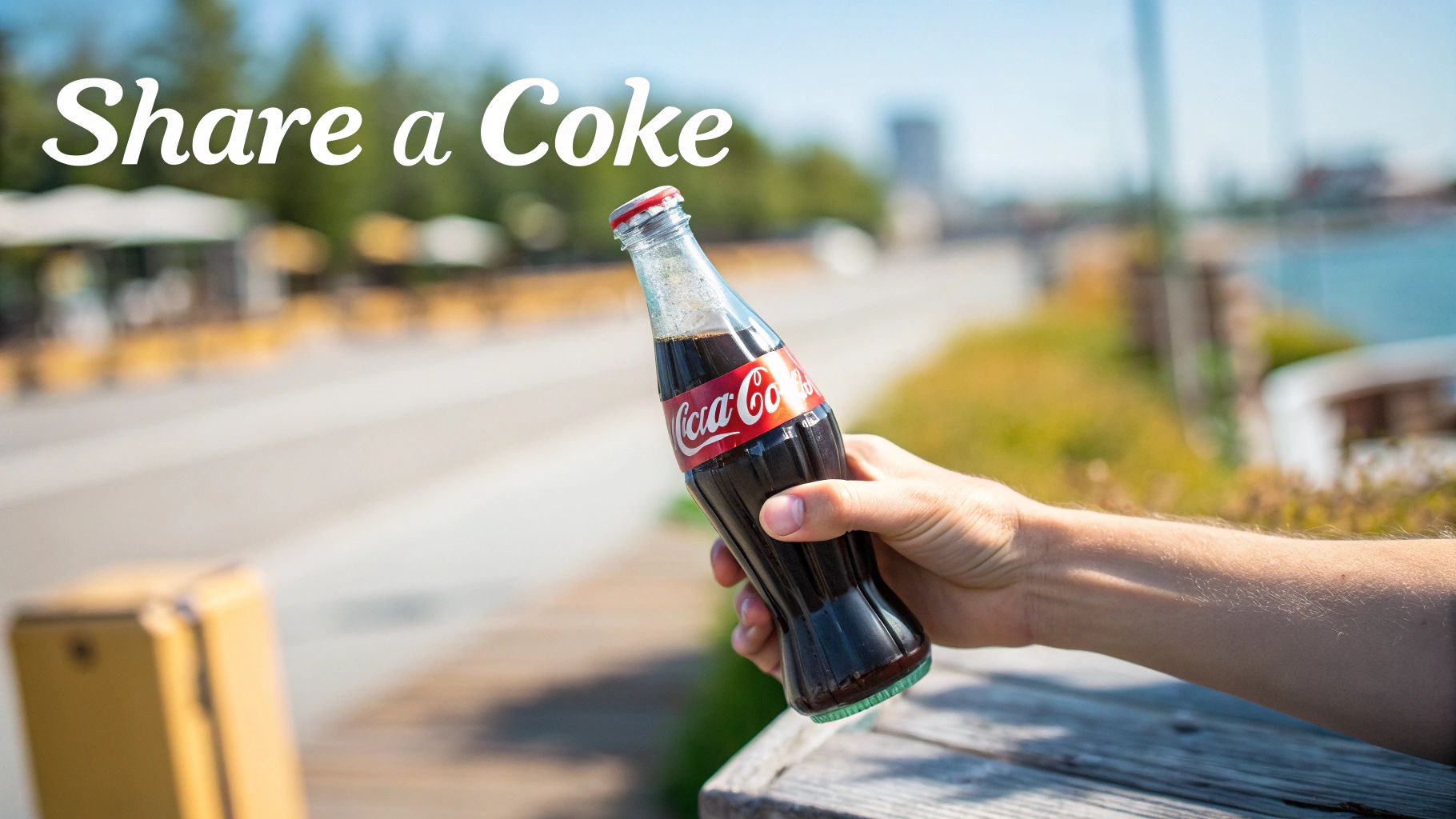
The campaign’s genius was its inherent shareability. Finding a bottle with a friend’s name became a social event, perfectly designed for the visual-first era of social media. It encouraged widespread user-generated content, turning every customer into a potential brand ambassador.
Strategic Breakdown
- Campaign Goal: Reconnect with younger consumers, drive sales during a slump, and generate significant social media buzz and user-generated content.
- Target Audience: Millennials and Gen Z who value personalization, social sharing, and authentic moments of connection.
- Channel Mix:
- Product Design: The personalized bottles and cans were the central, tangible element of the campaign.
- Social Media: Instagram, Facebook, and Twitter were flooded with photos using the #ShareACoke hashtag.
- Out-of-Home (OOH): Billboards and digital displays featured the campaign, often allowing for real-time personalization.
- Traditional Media: TV commercials depicted touching moments of people sharing personalized Cokes.
- Experiential Marketing: Interactive kiosks in public spaces allowed people to create and print their own custom Coke labels.
Actionable Takeaways for Your Business
This campaign shows that your product can be your best marketing channel. Even service-based businesses can find ways to personalize the customer experience.
- Make Your Product the Conversation Starter: Think about how you can physically or digitally alter your product or service to make it inherently shareable. This could be custom packaging, a personalized thank-you note, or a unique digital certificate.
- Create a Simple, Memorable Hashtag: The success of #ShareACoke was in its simplicity and clear call to action. Your hashtag should be easy to remember, spell, and directly related to the campaign's core idea.
- Combine Physical and Digital Experiences: Bridge the gap between the real world and online. If you have a physical location or product, create an experience that naturally encourages customers to share it online. This could be an "Instagrammable" spot in your store or a QR code on your product that leads to an interactive filter.
4. Glossier's Social-First DTC Beauty Campaign
Glossier redefined the direct-to-consumer (DTC) beauty industry by building its empire on a community-first, social-native foundation. Instead of treating social media as just another channel, Glossier made it the heart of its entire operation, using platforms like Instagram to drive product development, content creation, and sales. This is one of the most replicable integrated marketing campaign examples for modern DTC brands because it proves that community can be your most powerful asset.
The campaign’s genius was in its feedback loop. Glossier listened to what its audience wanted via its blog Into The Gloss and social comments, created products to meet those needs, and then empowered the same community to become its primary marketers through authentic user-generated content (UGC).
Strategic Breakdown
- Campaign Goal: Build a cult-like community, leverage UGC to drive authentic social proof, and create a seamless conversion funnel from social discovery to DTC purchase.
- Target Audience: Millennial and Gen Z consumers who are skeptical of traditional advertising and seek peer recommendations and authentic brand relationships.
- Channel Mix:
- Social Media: Instagram was the primary hub, featuring UGC, behind-the-scenes content, and product tutorials from real customers.
- SEO & Content: The Into The Gloss blog drove top-of-funnel traffic by answering beauty questions, which seamlessly led readers to Glossier products.
- Email Marketing: Segmented email lists nurtured social followers into repeat customers with personalized recommendations and user testimonials.
- Influencer Marketing: Partnerships with micro-influencers who were genuine fans of the brand, ensuring authentic and believable endorsements.
- E-commerce: The website was optimized for a direct path-to-purchase from social media, with landing pages reflecting the aesthetic and messaging seen on Instagram.
Actionable Takeaways for Your Business
This model is perfect for any brand looking to build a loyal following and bypass traditional retail gatekeepers. It thrives on authenticity and two-way communication.
- Treat Social as a Two-Way Street: Don't just post; listen. Use comments, DMs, and polls to gather direct feedback on what your customers want. Let their input guide your product development and content strategy.
- Build Your Email List from Social: Use lead magnets like exclusive content, early product access, or social contests to convert your social media followers into email subscribers. This gives you a direct line to your most engaged audience.
- Champion Your Customers: Actively search for and reshare UGC. Create a branded hashtag and feature your customers prominently on your feed. This not only provides you with a constant stream of free, authentic content but also makes your community feel seen and valued.
5. HubSpot's Inbound Marketing + Content-Led Campaign
HubSpot essentially wrote the book on inbound marketing, and their own strategy is a perfect illustration of a content-centric integrated campaign. Instead of outbound tactics, they attract customers by creating valuable content and experiences tailored to them. Their entire marketing ecosystem is built around a central hub of educational content designed to guide users from awareness to conversion. This is one of the most foundational integrated marketing campaign examples because it turns a company's website into a lead-generation machine.
The campaign’s core philosophy is to treat content as the primary asset. A single, comprehensive blog post or guide becomes the sun, with every other channel acting as a planet in its orbit, pulling traffic and engagement back to the core resource. This creates a cohesive user journey where every touchpoint provides value and builds trust.
Strategic Breakdown
- Campaign Goal: Establish industry thought leadership, generate a high volume of qualified leads, and nurture them through the sales funnel with automated, relevant content.
- Target Audience: Marketing managers, sales professionals, and small business owners looking for tools and strategies to grow their companies.
- Channel Mix:
- SEO & Content: Pillar pages and topic clusters optimized for high-intent keywords, with extensive blog content like "The 2024 Guide to Inbound Marketing."
- Email Marketing: Gated content (guides, templates) to build email lists, followed by automated nurture sequences that deliver relevant follow-up resources.
- Video: YouTube tutorials and webinar recordings that explain complex topics and demonstrate solutions.
- Social Media: LinkedIn and Twitter threads that repurpose key insights from blog posts, driving traffic back to the website.
- Paid Media: Google Ads campaigns targeting keywords directly related to their core content topics, ensuring visibility for high-intent searchers.
Actionable Takeaways for Your Business
This model is ideal for B2B companies or businesses with a longer sales cycle, where education and trust-building are paramount. By becoming the go-to resource, you attract prospects naturally.
- Create Pillar and Cluster Content: Identify a broad topic your audience cares about and create a comprehensive "pillar" page. Then, write shorter "cluster" posts that link back to it to build authority and improve your ability to increase organic traffic.
- Gate Your Best Assets: Offer your most valuable resources (e.g., ebooks, templates, webinar access) in exchange for an email address. This is the simplest way to convert content traffic into leads.
- Build Automated Nurture Workflows: Set up email sequences that are triggered when someone downloads a resource. The sequence should deliver more related content over time to guide them through their buying journey without manual effort.
6. GoPro's User-Generated Content + Video-First Campaign
GoPro’s marketing genius lies in its ability to turn its customers into its most powerful advertisers. The brand built an empire not just by selling cameras, but by creating a platform for users to share their most thrilling life moments. This strategy is one of the most effective integrated marketing campaign examples because it sources authentic, high-energy content directly from its community and distributes it across a unified, video-first ecosystem.
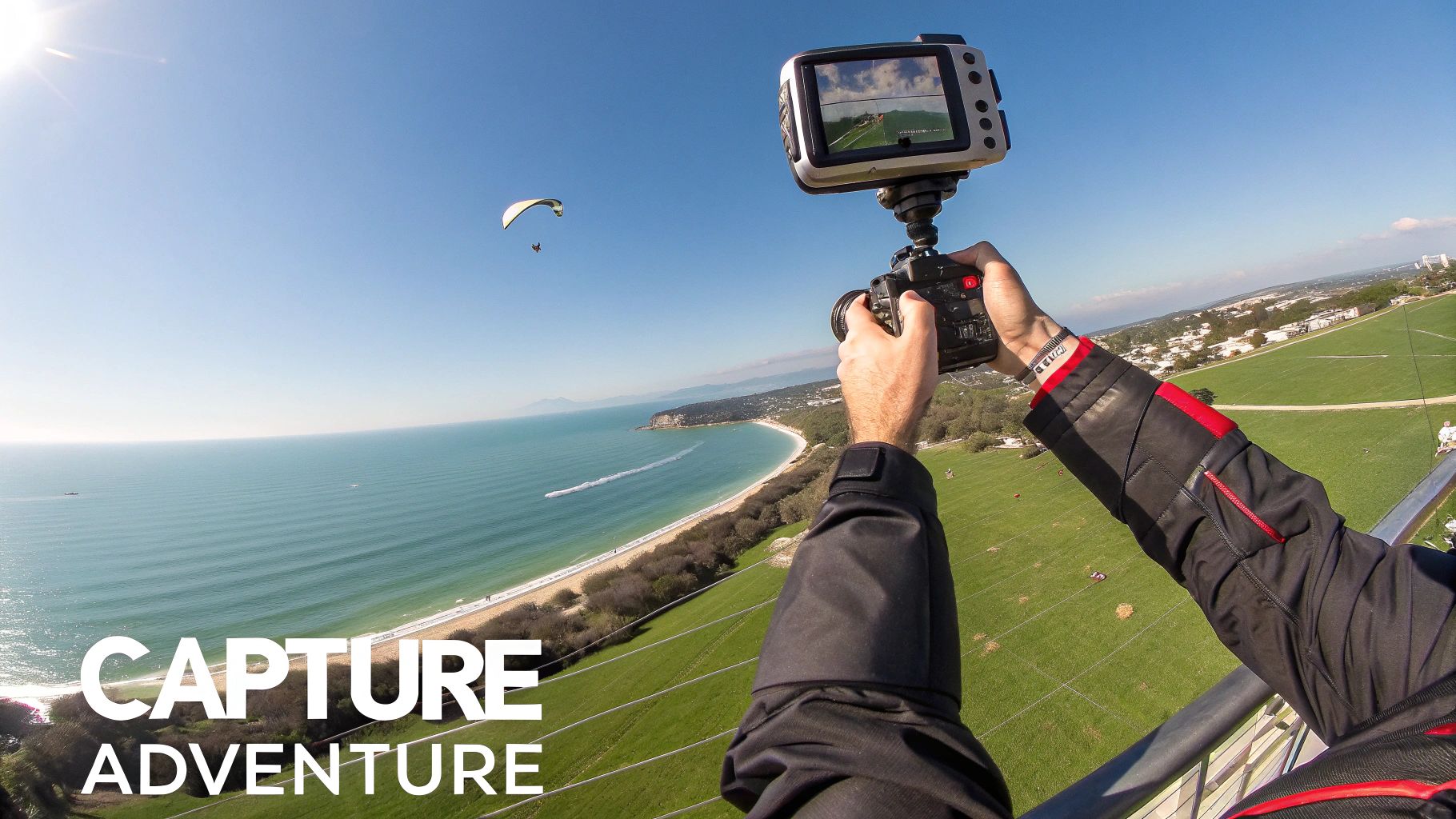
The campaign incentivizes creation through initiatives like the #GoProAwards, which offers cash prizes and exposure. This constant stream of breathtaking user-generated content (UGC) fuels every marketing channel, from YouTube to email, proving the product's value in the most compelling way possible: through real-life action.
Strategic Breakdown
- Campaign Goal: Drive brand awareness and sales by showcasing the product's capabilities through authentic user-generated video content.
- Target Audience: Adventure seekers, athletes, travelers, and content creators who want to capture high-quality action footage.
- Channel Mix:
- Video: The official GoPro YouTube channel serves as a central hub for the best UGC, tutorials, and product launches.
- Social Media: Instagram Reels, TikTok videos, and Facebook posts feature daily highlights of stunning customer footage.
- Community & Contests: The annual #GoProAwards and ongoing challenges encourage a steady flow of high-quality submissions.
- Email Marketing: Weekly newsletters like "Watch This Week's Best GoPro Moments" keep the community engaged and highlight top creators.
- Influencer Marketing: Partnerships with professional athletes and adventure influencers provide credible, aspirational content.
Actionable Takeaways for Your Business
This model is perfect for any business whose product or service enables a visually compelling experience. By empowering your customers to become creators, you build an authentic and scalable content engine.
- Create an Incentive Program: Launch a branded hashtag and offer meaningful incentives for user submissions. This can include cash prizes, free products, or simply featuring their content prominently on your channels.
- Establish a Content Hub: Use a primary channel, like a YouTube playlist or a dedicated page on your website, to showcase the best UGC. This creates a go-to destination for your community.
- Integrate UGC into Every Channel: Don't just post user content on social media. Feature it in your email newsletters, on product pages, and even in digital ads to provide social proof and authenticity at every touchpoint.
7. Spotify's Data-Driven Personalized Marketing Campaign
Spotify's annual 'Wrapped' campaign is the gold standard for turning user data into a global cultural event. The core strategy leverages individual listener data to create hyper-personalized, shareable content that makes each user feel seen. This is a brilliant example of an integrated marketing campaign example because it transforms a data report into a highly anticipated, multi-channel celebration of music and personal identity.
By combining owned data with a creative, user-centric concept, Spotify generates massive organic reach and reinforces its brand as an indispensable part of its users' lives. The campaign's success lies in its ability to make data feel emotional, personal, and profoundly shareable.
Strategic Breakdown
- Campaign Goal: Drive user engagement, increase brand loyalty, and generate massive organic social media buzz by turning personal data into a shareable cultural moment.
- Target Audience: All Spotify users, with a heavy focus on digitally native Millennials and Gen Z who are active on social media.
- Channel Mix:
- In-App Experience: The core personalized "Wrapped" story that users swipe through.
- Email Marketing: Personalized emails summarizing listening habits and driving users to their full Wrapped report.
- Social Media: Easily shareable cards formatted for Instagram Stories, TikTok, and X, fueled by user-generated content and artist participation.
- Outdoor Advertising: Billboards featuring fun, aggregated listener stats specific to a city or region (e.g., "The one person who listened to the 'sad indie' playlist for 4,300 hours this year. You okay?").
- Artist Partnerships: Providing artists with their own "Wrapped" stats to share with their fanbases.
Actionable Takeaways for Your Business
Even without Spotify's vast data, you can adopt a similar personalization-first mindset. This strategy helps boost brand awareness by making customers feel unique.
- Leverage Your Own Data: Create an annual "year in review" for your customers. An e-commerce store could highlight a customer's favorite product category, number of purchases, or most-viewed item.
- Design for Shareability: When creating personalized content, build in "share" buttons and pre-format assets for popular platforms like Instagram Stories. Make it as easy as possible for users to post their results.
- Combine Individual and Aggregate Insights: While personal stats are powerful, use aggregated data to create compelling content for wider audiences. For example, share "This Year's Most Popular Product in San Diego" on your social channels to create local relevance.
8. Patagonia's Values-Driven Integrated Campaign
Patagonia’s marketing is a powerful case study in making a brand’s mission the core of its message, rather than a secondary element. The company's strategy fully integrates environmental activism and corporate responsibility into every marketing touchpoint, treating its values as the primary product. This makes it one of the most authentic integrated marketing campaign examples because its message isn't just a campaign; it's the entire brand's reason for being.
The brand moves beyond traditional advertising by focusing on storytelling, advocacy, and community mobilization. By creating content that highlights environmental issues and conservation efforts, Patagonia builds a deeply loyal following that shares its values, turning customers into advocates for both the brand and the planet.
Strategic Breakdown
- Campaign Goal: To build a mission-driven brand that attracts and retains customers based on shared values, driving long-term loyalty over short-term sales.
- Target Audience: Environmentally conscious consumers, outdoor enthusiasts, and activists who prioritize sustainability, transparency, and corporate responsibility.
- Channel Mix:
- Video: Long-form documentaries on YouTube like 'Saving Our Future' that spotlight conservation efforts, completely separate from product promotion.
- Email Marketing: "Take Action" emails that mobilize subscribers to support environmental causes or contact officials, shifting the focus from sales to activism.
- Social Media: Instagram posts featuring partnerships with NGOs and calls-to-action that align with their mission.
- SEO & Content: Transparent blog articles detailing their carbon footprint, supply chain ethics, and sustainability initiatives to build trust.
- Community Partnerships: Collaborations with grassroots environmental organizations, lending credibility and amplifying their impact.
Actionable Takeaways for Your Business
This model is perfect for mission-driven businesses aiming to build a loyal community around a shared purpose, proving that values can be a powerful market differentiator.
- Integrate Your Mission Everywhere: Your company's core values shouldn't just live on an "About Us" page. Weave them into your product descriptions, email newsletters, social media content, and customer service interactions.
- Mobilize, Don't Just Market: Use your channels, particularly email and social media, to empower your audience. Encourage them to take specific actions related to your mission, whether it's signing a petition, volunteering, or making a lifestyle change.
- Prioritize Transparency Over Perfection: Be honest about your journey, including your challenges and shortcomings. A blog post detailing how you're working to reduce your carbon footprint, even if you're not there yet, builds more trust than pretending to be perfect.
9. Nike's 'Just Do It' Multi-Channel Athlete-Driven Campaign
Nike's 'Just Do It' is more than a slogan; it's a cultural phenomenon built on decades of masterful integrated marketing. The campaign's brilliance lies in its ability to connect a simple, powerful ethos with the world's most inspiring athletes, creating a narrative of perseverance and greatness. This campaign is one of the most enduring integrated marketing campaign examples because it flawlessly translates this core message across every touchpoint, from global television events to intimate social media moments.
The strategy uses athlete storytelling as its foundation. Instead of just showcasing products, Nike tells the human stories behind the sweat, sacrifice, and triumph. By aligning with icons like Serena Williams and LeBron James, the brand doesn't just sell shoes; it sells the aspiration to overcome any obstacle.
Strategic Breakdown
- Campaign Goal: Reinforce Nike's brand identity as a symbol of determination and athletic excellence, drive emotional connection, and maintain market leadership.
- Target Audience: A broad audience of athletes and aspiring athletes, from casual gym-goers to professional competitors, who are motivated by stories of resilience.
- Channel Mix:
- Video: High-impact TV commercials and long-form YouTube documentaries detailing an athlete's journey.
- Social Media: Athlete-driven Instagram Reels showing behind-the-scenes training and TikTok partnerships with emerging athletes sharing their "Just Do It" moments.
- Email Marketing: Weekly motivational emails featuring different athlete stories and product tie-ins.
- Retail & Events: In-store activations and athlete appearances that connect the digital campaign to a physical experience.
- Sponsorships: Podcast and event sponsorships that place the brand within relevant cultural conversations.
Actionable Takeaways for Your Business
Even without a Nike-sized budget, the principle of inspirational storytelling is highly replicable. Connect your brand's purpose to the personal stories of your customers or local heroes.
- Find Your "Athletes": Identify brand ambassadors or customers who embody your brand's core values. They don't need to be famous; they need to be authentic.
- Create a "Hero" Story: Develop one powerful piece of content, like a short documentary or a detailed blog post, about your ambassador's journey. This becomes your central asset.
- Atomize and Distribute: Break the hero story into smaller pieces. Use short video clips for social media, pull-quotes for graphics, and key anecdotes for email newsletters to ensure a consistent message across all channels.
10. Warby Parker's Community-First Local SEO Campaign
Warby Parker’s approach to opening physical retail stores is a masterclass in blending digital precision with genuine community engagement. The brand didn't just open stores; it launched hyperlocal ecosystems designed to dominate local search and build authentic neighborhood connections from day one. This strategy stands out among integrated marketing campaign examples because it transformed SEO from a technical task into a community-building exercise, driving both online discovery and in-store foot traffic.
The campaign’s core was to make each new store feel like it had always been part of the community. By integrating local partnerships, targeted social content, and perfectly optimized local landing pages, Warby Parker ensured that when someone searched "glasses near me," they didn’t just find a store; they found a trusted local provider.
Strategic Breakdown
- Campaign Goal: Dominate local search results for each new store location, drive significant foot traffic, and build immediate brand affinity within the community.
- Target Audience: Style-conscious consumers in specific urban and suburban neighborhoods seeking affordable, high-quality eyewear from a socially responsible brand.
- Channel Mix:
- SEO & Web: Highly optimized Google Business Profiles and location-specific landing pages (e.g., "Glasses in [City Name]").
- Content: Blog posts featuring city guides and eye health tips relevant to the local community.
- Partnerships: Sponsoring local school eye health programs and collaborating with neighborhood artists for in-store murals.
- Social Media: Instagram posts introducing the local team ("Meet the [City] Team") and highlighting community involvement.
- Email Marketing: Geotargeted email campaigns with grand-opening offers and announcements.
- Video: YouTube testimonials from real customers sharing their positive experiences at a specific store location.
Actionable Takeaways for Your Business
This model is perfect for any business with a physical presence, from retail to local services. It proves that local marketing thrives on authenticity and integration.
- Treat Your Google Business Profile as Your Local Homepage: Fully complete every section of your GBP. Regularly upload high-quality photos of your space, team, and products, and actively solicit and respond to customer reviews.
- Create Hyper-Local Content: Don't just make a generic landing page. Write a blog post about the "5 Best Coffee Shops Near Our [Neighborhood] Store" or partner with a local influencer to create a guide. This builds local relevance and backlinks.
- Build Real-World Partnerships: Sponsor a local youth sports team, host a charity event, or offer a discount to members of a nearby business. These activities generate genuine goodwill and valuable local press mentions that boost SEO.
10 Integrated Marketing Campaigns Comparison
| Campaign | Implementation Complexity 🔄 | Resource Requirements ⚡ | Expected Outcomes 📊 | Ideal Use Cases 💡 | Key Advantages ⭐ |
|---|---|---|---|---|---|
| Airbnb — "Belong Anywhere" | High 🔄 — multi-market coordination | High ⚡ — long-form production & ops | Brand lift (+33%); long-term loyalty, organic reach | Service providers, travel & lifestyle brands | Emotional storytelling; UGC-driven authenticity ⭐⭐⭐ |
| Dollar Shave Club — Viral Video | Low-Medium 🔄 — one hero asset | Low ⚡ — inexpensive production | Rapid viral reach (12M+ views); fast subscriber growth 📊 | SMBs / launches needing breakout moment | Highly shareable hero content; strong brand voice ⭐⭐⭐ |
| Coca‑Cola — "Share a Coke" | High 🔄 — packaging + global roll-out | High ⚡ — manufacturing + media spend | Sales lift (+2%); 1.9M UGC posts; strong retail impact 📊 | Large CPGs; retail campaigns linking product & social | Product-as-marketing; Instagrammable UGC & retail lift ⭐⭐⭐ |
| Glossier — Social‑First DTC | Medium 🔄 — continuous community management | Medium ⚡ — content + community team | Sustainable organic growth; high repeat purchases 📊 | DTC beauty/e-commerce with community focus | Social-native funnels; product feedback loop & LTV ⭐⭐⭐ |
| HubSpot — Inbound / Content | Medium-High 🔄 — editorial + automation workflows | Medium-High ⚡ — content production & paid support | Sustained SEO traffic; high-quality leads over time 📊 | B2B SaaS; lead generation & thought leadership | Scalable SEO + nurture; measurable lead attribution ⭐⭐⭐ |
| GoPro — UGC + Video‑First | Medium 🔄 — curation & community ops | Low-Medium ⚡ — incentives & community tools | Billions of views; continuous content supply & advocacy 📊 | Experiential products & adventure brands | Authentic UGC at scale; cost-effective content stream ⭐⭐⭐ |
| Spotify — Data‑Driven Personalization | High 🔄 — data integration & cross‑channel sync | High ⚡ — data infra, analytics & creative | High engagement; cultural moments (Wrapped); strong ROI 📊 | Data-rich consumer apps & platforms | Hyper-personalization driving engagement & shareability ⭐⭐⭐ |
| Patagonia — Values‑Driven | Medium 🔄 — partnerships & transparency demands | Medium ⚡ — storytelling & partner programs | Strong loyalty & earned media; indirect ROI 📊 | Mission-driven orgs and nonprofits | Authentic values alignment; premium positioning ⭐⭐ |
| Nike — Athlete‑Driven | High 🔄 — talent coordination & event ops | High ⚡ — talent fees & premium production | Strong brand equity; social engagement & retail activation 📊 | Sports / lifestyle brands with large budgets | Credibility via athletes; multi-touch emotional storytelling ⭐⭐⭐ |
| Warby Parker — Local SEO + Community | Medium 🔄 — multi‑location coordination | Medium ⚡ — local content & ops teams | Dominant local search; increased foot traffic & conversions 📊 | Omnichannel retailers with physical stores | Local SEO dominance; community trust & review signals ⭐⭐⭐ |
From Inspiration to Action: Building Your Own Integrated Campaign
The journey through these diverse integrated marketing campaign examples, from GoPro’s user-generated content engine to Warby Parker’s community-centric local SEO, reveals a powerful, unifying truth. Success is not born from a single viral video, a clever ad, or a high-ranking blog post. True, sustainable growth emerges from the seamless integration of these elements into a cohesive and compelling brand narrative.
The common thread is not an astronomical budget; it is a relentless commitment to a unified strategy. Each campaign we explored began with a core idea, a central promise, and then meticulously wove it through every conceivable customer touchpoint. This creates a brand experience that feels consistent, authentic, and deeply resonant.
The Core Principle: A Unified Strategy, Not Siloed Tactics
The most critical takeaway is the shift from a channel-first to a customer-first mindset. Instead of asking, "What should we post on social media?" or "How can we improve our SEO?" the leaders behind these campaigns asked, "What story do we need to tell, and how can each channel play its part in telling it?"
- Dollar Shave Club didn't just create a funny video; they used it as the anchor for their entire direct-to-consumer launch, aligning their social voice, email marketing, and PR around that single, disruptive concept.
- Patagonia doesn’t just run ads about environmentalism; their values are embedded in their product, their content, their events, and their corporate activism, creating an unshakeable brand identity.
- HubSpot built an empire not by shouting about their software, but by becoming the definitive educational resource for their audience, integrating content across their blog, academy, and events to build trust first.
This synergy is where the magic happens. A well-executed social media campaign drives traffic to a search-optimized website. A powerful story-driven video provides assets for targeted ad campaigns. A local community event generates authentic user-generated content and valuable backlinks for local SEO. Each piece amplifies the others, creating a marketing engine that is far greater than the sum of its parts.
Actionable Next Steps: Your Path to Integration
Feeling inspired is one thing; taking action is another. For small and mid-sized businesses, especially those in competitive markets like San Diego, the idea of launching a multi-channel campaign can feel daunting. The key is to start with a focused, manageable approach. You don't need to be on every platform at once.
- Define Your Central Message: Before you choose a single channel, what is the one core idea you want your audience to remember? Is it convenience, expertise, community, or unparalleled quality? This is your strategic anchor.
- Identify Your Primary Channels: Where does your target audience spend their time? Pick two or three channels that align with your message and your audience's behavior. A local service provider might focus on Google Business Profile, local SEO, and a targeted Facebook Ads campaign. A DTC e-commerce brand might prioritize Instagram, TikTok video content, and email marketing.
- Create a Cohesive Creative Concept: Develop a visual style, tone of voice, and key messaging that can be adapted across your chosen channels. Your website’s hero image, your social media posts, and your video content should all feel like they belong to the same family.
- Measure and Iterate: Establish clear KPIs for each channel that roll up to a single, overarching campaign goal, such as lead generation or online sales. Use data to understand what’s working and double down on those tactics while refining or eliminating what isn’t.
Mastering the art of the integrated campaign is no longer a luxury reserved for global brands. It is the new standard for effective marketing. By breaking down the silos between your marketing efforts, you create a seamless customer journey that builds trust, fosters loyalty, and drives measurable growth. The examples in this article provide the blueprint; now it's your turn to build.
Navigating the complexities of a truly integrated strategy requires a partner who sees the whole picture. Danny Avila specializes in weaving together story-driven video, search-first web design, and community-focused social media into a single, powerful engine for growth. If you’re ready to move beyond isolated tactics and build a cohesive marketing system that delivers results, explore what a unified partnership can do for your brand at Danny Avila.