
In a crowded digital marketplace, simply posting isn't enough. The secret to standing out, engaging customers, and driving real growth lies in mastering the right type of social media content for the right moment. Many businesses fall into a rhythm of posting the same format repeatedly, hitting a growth ceiling without understanding why. The reality is that different content formats serve distinct business goals, from building brand awareness with viral short-form video to nurturing high-value leads with detailed case studies.
This guide is a comprehensive roundup for marketing leaders and business owners, designed to move beyond theory and into actionable strategy. We will break down the 12 most effective content formats that deliver measurable results today. For each one, you'll find its strategic purpose, ideal platforms, quick production tips, and the specific performance signals to track.
Think of this as a blueprint for building a powerful, diversified content engine. You'll learn not just what to post, but why and how to post it, enabling you to connect with your audience, from local San Diego service providers to national e-commerce brands, and turn engagement into tangible business outcomes. Let's dive in.
1. Short-Form Video (Reels & Shorts)
Short-form video is a dominant type of social media content, consisting of vertical videos typically 15 to 90 seconds long. Platforms like Instagram Reels, TikTok, and YouTube Shorts prioritize this format, pushing it to new audiences through powerful algorithms. This makes it a non-negotiable tool for brands focused on boosting discovery, reach, and community engagement. Its fast-paced, engaging nature captures attention quickly in crowded social feeds.

Why It Works & Quick Tips
This format thrives because it’s easily digestible and highly shareable, aligning perfectly with modern mobile viewing habits. Businesses can use it to showcase products, share quick tutorials, or participate in trending conversations to humanize their brand. For example, a local real estate agent can post 30-second property walkthroughs, while a law firm answers a common legal question in a minute.
- Hook Instantly: Grab attention within the first three seconds with strong visuals or a compelling question.
- Use Trending Audio: Leverage popular sounds to increase your video’s visibility on the platform’s discovery pages.
- Add Captions: Design for silent viewing, as most users watch videos without sound. Captions make your content accessible.
- Post Consistently: Aim for at least 3-5 short-form videos per week to build momentum with the algorithm.
To create professional-looking videos without a large budget, you can get started with just a smartphone. For a deeper dive, explore these tips on how to film a high-quality marketing video for social media.
2. Carousel Posts (Multi-Image Slides)
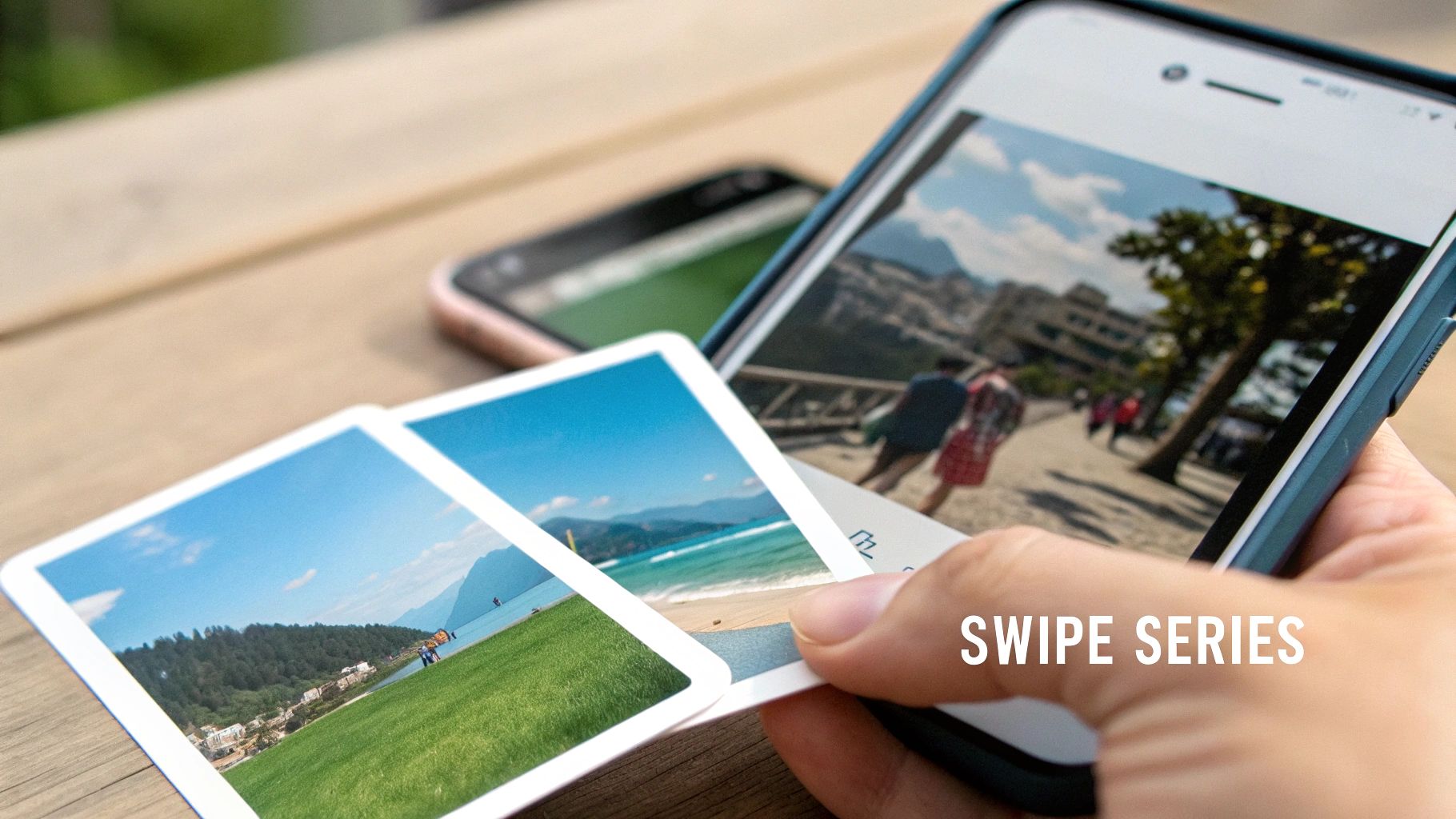
Carousel posts are a versatile type of social media content featuring multiple images or videos that users can swipe through in a single post. Popular on Instagram, LinkedIn, and Facebook, this format allows for deeper storytelling, breaking down complex information into digestible slides. By encouraging users to swipe, carousels significantly increase time spent on your post, signaling higher engagement to platform algorithms and boosting overall reach.
Why It Works & Quick Tips
This format excels at educating audiences and showcasing value without overwhelming them. It’s perfect for step-by-step guides, product feature highlights, or sharing a collection of customer testimonials. For instance, a home services company can display a before-and-after transformation across several slides, while a healthcare clinic can explain a complex procedure in a simple, visual sequence.
- Hook with the First Slide: Use a compelling title, question, or striking visual on the first slide to encourage a swipe.
- Maintain Visual Consistency: Use consistent branding, fonts, and colors across all slides to create a cohesive and professional look.
- Guide the User: Add visual cues like arrows or "Swipe left" text to prompt users to continue through the carousel.
- End with a Strong CTA: The final slide is a prime spot for a clear call to action, such as "Visit our website" or "Save this post."
For more visual inspiration, review these powerful photography ideas for social media content that can be adapted for a carousel format.
3. User-Generated Content (UGC) & Community Posts
User-Generated Content (UGC) is a powerful type of social media content created by your customers, fans, and community members instead of your brand. It includes everything from tagged photos and video testimonials to product reviews and contest submissions. Leveraging UGC builds immense social proof and authenticity, as consumers trust recommendations from peers far more than branded messages. This strategy turns your audience into brand advocates, reducing your content creation workload while boosting credibility.
Why It Works & Quick Tips
This format excels at fostering community and driving conversions. It provides authentic, relatable content that resonates deeply with potential customers. For instance, a home services contractor can share client project photos, while a local cafe can feature customer pictures tagged at their location. This not only showcases your offerings in real-world settings but also celebrates your community, strengthening loyalty.
- Create a Branded Hashtag: Encourage customers to use a unique hashtag (e.g., #YourBrandStory) to easily find and collect submissions.
- Offer Incentives: Motivate participation by offering discounts, features on your page, or entry into a giveaway for those who share content.
- Always Ask for Permission: Before reposting, message the original creator to get their consent and ensure you credit them properly in your caption.
- Respond & Engage: Acknowledge every submission with a like, comment, or share to show appreciation and encourage more participation.
4. Educational & How-To Content
Educational content is a foundational type of social media content designed to teach, inform, and empower your audience. It answers common questions, breaks down complex topics, and provides actionable advice through formats like tutorials, guides, and industry explainers. By offering genuine value without an immediate sales pitch, this strategy builds trust, establishes your brand as an authority, and attracts an engaged audience actively seeking solutions. It's a powerful tool for nurturing leads and driving organic reach through shares and saves.
Why It Works & Quick Tips
This format works because it directly addresses your audience's pain points, positioning your brand as a credible resource. It captures users with high intent who are searching for answers, making them more receptive to your services later. For example, a home services company can share a DIY guide on simple plumbing fixes, while a healthcare provider can create a post explaining preventative care tips.
- Solve a Specific Problem: Base content on frequently asked questions from your clients to ensure relevance and utility.
- Break It Down: Simplify complex subjects into digestible steps using lists, carousels, or short videos.
- Use Clear Visuals: Incorporate diagrams, infographics, or screen recordings to make instructions easy to follow.
- Create a Series: Turn a broad topic into a multi-part series (e.g., "Home Buying 101: Part 1") to encourage follows.
5. Video Testimonials & Case Studies
Video testimonials are an incredibly persuasive type of social media content that features real customers sharing their positive experiences. Ranging from 30-second clips to in-depth 5-minute case studies, this format builds trust and credibility by providing authentic social proof. It moves beyond a brand talking about itself and lets satisfied clients become your most effective advocates, which is crucial since most consumers trust peer recommendations over branded advertising.
Why It Works & Quick Tips
This format converts prospects by answering their biggest question: "Will this work for someone like me?" It provides a relatable, human story that showcases tangible results. For instance, a home service company can film a client’s reaction to a finished renovation, while a nonprofit can feature a beneficiary explaining the program’s impact on their life. This authentic storytelling resonates deeply and drives action.
- Ask Specific Questions: Guide the conversation by asking about the initial challenge, the solution provided, and the specific results achieved.
- Prioritize Audio Quality: Use a lavalier or boom mic. Clear, professional audio is more critical than video for establishing credibility.
- Add Text Overlays: Display the customer's name, title, and company to add context and authority.
- Show, Don't Just Tell: Include B-roll footage of the customer using your product or service to make the story more dynamic and believable.
6. Stories (Ephemeral Content)
Stories are a dynamic type of social media content, consisting of vertical photos and videos that disappear after 24 hours. Pioneered by Snapchat and popularized by Instagram, this ephemeral format creates urgency and offers a raw, behind-the-scenes look at a brand. Found on platforms like Instagram, Facebook, and LinkedIn, Stories are perfect for fostering authentic, frequent touchpoints with your most engaged followers. Their temporary nature encourages immediate viewing and interaction.
Why It Works & Quick Tips
This format excels at building community and driving timely action because it feels personal and unpolished. Businesses can use Stories for real-time event coverage, quick Q&As, flash sales, or sharing user-generated content to build social proof. For instance, a local cafe can post daily specials that vanish at closing time, while a nonprofit can share live updates from a fundraising event to encourage last-minute donations.
- Be Interactive: Use stickers like polls, quizzes, and question boxes to actively engage viewers and gather feedback.
- Create Urgency: Announce limited-time offers or use countdown timers for product launches to drive immediate action.
- Showcase Authenticity: Share unedited, behind-the-scenes moments of your team or daily operations to humanize your brand.
- Use Highlights: Save your best-performing Stories to your profile Highlights to categorize important information like FAQs or testimonials.
7. Live Streaming & Live Shopping
Live streaming is a type of social media content where you broadcast real-time video directly to your audience on platforms like Instagram, Facebook, and TikTok. This format excels at creating urgency, authenticity, and direct two-way interaction that pre-recorded content can't match. Its unscripted nature fosters a genuine connection, making it ideal for building trust and driving immediate action, from answering questions to making on-the-spot purchases.
Why It Works & Quick Tips
This format thrives on its ability to generate high engagement and a strong sense of community. By interacting with viewers in real time, brands can humanize their operations and receive instant feedback. For example, an e-commerce store can host a live shopping event to demonstrate a new product and answer customer questions, while a consultant can run a live Q&A session to establish their expertise and generate leads.
- Promote in Advance: Announce your live stream 24-48 hours beforehand to build anticipation and maximize attendance.
- Test Your Setup: Before going live, check your internet connection, audio, and lighting to ensure a smooth, professional broadcast.
- Engage with Comments: Have a moderator or co-host ready to manage the chat, read comments aloud, and make viewers feel included.
- End with a Clear CTA: Conclude your stream by telling your audience exactly what to do next, whether it’s visiting a link, signing up, or making a purchase.
8. Infographics & Data Visualization
Infographics and data visualizations are a powerful type of social media content that translates complex data, statistics, and processes into easily digestible visual formats. By combining text, charts, and icons, they make intricate information accessible and highly shareable. This format is ideal for establishing authority, simplifying concepts, and creating evergreen assets that drive traffic and engagement long after they are posted.
Why It Works & Quick Tips
This format succeeds because it caters to the human brain's preference for visual information, making dense topics like market research or survey results understandable at a glance. For example, a marketing agency can visualize key findings from its annual industry report, while a financial advisor can create a flowchart illustrating a retirement planning process. These visuals are often saved and referenced by users, extending their value.
- Tell a Clear Story: Start with a compelling headline and guide the viewer through the data logically.
- Prioritize Readability: Use a clean layout, large fonts, and a consistent color palette that aligns with your brand.
- Keep Text Minimal: Use concise copy and let the visuals do the heavy lifting. Focus on key takeaways.
- Cite Your Sources: Add credibility by including a small section at the bottom that attributes your data.
To simplify the design process, tools like Canva and Venngage offer user-friendly templates that can be customized to fit your brand. For a comprehensive guide on making your visuals pop, consider these data visualization best practices.
9. Memes & Trending Content
Memes and trending content are a powerful type of social media content that leverages humor and cultural relevance to boost engagement. This format involves adapting popular internet jokes, viral sounds, or current events to your brand’s niche. By participating in conversations your audience is already having, you can humanize your brand, foster a sense of community, and create highly shareable posts that spread rapidly. Brands that tap into relevant trends can see significantly higher engagement rates.
Why It Works & Quick Tips
This format succeeds because it feels native to the platform and taps into shared cultural knowledge, making your brand appear more relatable and less corporate. For example, a software company could use a popular meme format to illustrate a common frustration their product solves. A local cafe could participate in a trending TikTok audio to showcase its daily routine in a fun way.
- Act Quickly: Trends have a short lifespan. Monitor platforms like TikTok and X (formerly Twitter) to catch them early and post while they are still relevant.
- Stay Brand-Aligned: Don't force a trend that doesn't fit. Adapt humor and topics to your brand's voice and ensure it resonates with your target audience.
- Know Your Audience: Understand what your followers find funny and relatable. What works for a Gen Z audience may not land with B2B professionals.
- Balance Your Content: Use memes to supplement your content strategy, not replace it. Mix humorous posts with educational and promotional content.
To stay on top of what’s new, dedicate time to browsing discovery pages and see what creators in your space are doing. For more on creating a balanced feed, explore this guide on developing a social media content calendar.
10. Long-Form Content (Blog Posts, Articles, Whitepapers)
Long-form content is a strategic type of social media content that involves creating detailed, comprehensive written pieces like blog posts, articles, and whitepapers, often exceeding 1,000 words. While published on a website, this content is heavily promoted and shared across social platforms to drive traffic and establish authority. It serves as a cornerstone asset for attracting qualified leads, ranking in search engines, and providing immense value to an audience.
Why It Works & Quick Tips
This format works by positioning your brand as a definitive expert. It answers complex customer questions thoroughly, building trust that short-form content cannot. For instance, a home services company could publish an "Ultimate Guide to Water Heater Maintenance," while a healthcare provider could release a whitepaper on local wellness trends. These resources attract high-intent audiences and can be repurposed into dozens of smaller social media posts.
- Target Search Intent: Build content around keywords your ideal customers are actively searching for.
- Structure for Scannability: Use H2 and H3 subheadings, bullet points, and short paragraphs to make long articles easy to read.
- Include Rich Media: Add visuals like charts, infographics, and videos every 200-300 words to break up text and improve engagement.
- Promote Extensively: Share your published article across all social channels, in email newsletters, and through targeted ads to maximize its reach.
To dive deeper into driving visitors to your long-form pieces, explore these strategies on how to increase organic traffic.
11. Polls & Interactive Content
Polls and interactive features are a simple yet powerful type of social media content designed to generate direct audience participation. This format includes questions, quizzes, and surveys posted on platforms like Instagram Stories, X (formerly Twitter), and Facebook. By prompting followers to share their opinions with a single tap, interactive content can generate twice the engagement of static posts, making it a valuable tool for gathering feedback and building community. Its low-barrier-to-entry nature encourages users to engage instantly.
Why It Works & Quick Tips
This format succeeds by turning passive scrolling into active participation, giving your audience a voice and making them feel heard. Businesses can use polls to conduct quick market research, ask for product feedback, or simply start a fun conversation. For instance, a coffee shop could ask followers to vote on a new seasonal drink flavor, while a marketing agency could poll its audience on their biggest industry challenge.
- Keep It Simple: Use clear questions with 2-4 distinct answer choices to make voting easy.
- Share the Results: Follow up by sharing the poll's outcome and any insights, which closes the loop and encourages future participation.
- Drive Further Action: Use the results to create follow-up content. If a particular service wins a poll, create a post detailing its benefits.
- Use Quizzes for Personalization: Create personality or knowledge quizzes that provide personalized results, as these are highly shareable and effective for lead generation.
12. Email Content & Newsletters
While not posted on a public feed, email newsletters are a powerful type of social media content because they leverage your social following to build a privately-owned audience. This channel delivers curated content directly to subscribers, creating a direct line of communication that isn't dependent on unpredictable platform algorithms. For businesses, email marketing consistently generates the highest ROI, making it a critical tool for nurturing leads and driving conversions.
Why It Works & Quick Tips
Email marketing works because it fosters a deeper, more personal connection with your audience. Unlike a crowded social feed, an email in a personal inbox commands more focused attention. Businesses can use newsletters to share exclusive content, announce product updates, or deliver educational series that build authority and trust. For instance, an e-commerce brand can send targeted promotions, while a consultant can distribute a weekly industry insights email.
- Offer a Lead Magnet: Grow your list by offering a valuable freebie (e.g., a guide, template, or discount) in exchange for an email address.
- Write Compelling Subject Lines: Keep subject lines clear, concise (around 40-50 characters), and intriguing to boost open rates.
- Segment Your Audience: Group subscribers by interests, purchase history, or engagement level to send more relevant and personalized content.
- Include a Clear Call-to-Action (CTA): Every email should guide the reader toward a single, specific action, such as "Read the Blog Post" or "Shop the Sale."
Platforms like ConvertKit and Substack have made it easier than ever to create and manage professional newsletters. To get started, consider these email marketing best practices.
12 Social Media Content Types Comparison
| Content Type | Implementation Complexity 🔄 | Resource Requirements ⚡ | Expected Outcomes ⭐📊 | Ideal Use Cases | Key Advantages 💡 |
|---|---|---|---|---|---|
| Short-Form Video (Reels & Shorts) | 🔄 Medium — fast editing cadence | ⚡ Low–Medium — smartphone + editor; consistent posting | ⭐⭐⭐⭐ 📊 High reach & viral discovery | Product demos, trends, brand discovery | 💡 Highest organic distribution; cost-effective |
| Carousel Posts (Multi-Image Slides) | 🔄 Medium — multi-slide design cohesion | ⚡ Medium — multiple images/design time | ⭐⭐⭐ 📊 Strong engagement & extended attention | Step-by-step guides, before/afters, product breakdowns | 💡 Enables deeper storytelling in one post |
| User-Generated Content (UGC) & Community Posts | 🔄 Low–Medium — curation & rights mgmt | ⚡ Low — community-sourced assets, moderation time | ⭐⭐⭐⭐ 📊 High trust & conversion lift | Testimonials, community campaigns, social proof | 💡 Authenticity with low production cost |
| Educational & How-To Content | 🔄 Medium–High — research and structure | ⚡ Medium — SME time, content production | ⭐⭐⭐⭐ 📊 Authority, SEO traffic, long-term value | Tutorials, legal/health explainers, evergreen guides | 💡 Positions brand as trusted resource |
| Video Testimonials & Case Studies | 🔄 High — scheduling, on-set direction | ⚡ High — filming, editing, permissions | ⭐⭐⭐⭐⭐ 📊 Highest trust and conversion influence | B2B case studies, service provider proofs | 💡 Strongest social proof; highly repurposable |
| Stories (Ephemeral Content) | 🔄 Low — informal, frequent posting | ⚡ Low — smartphone; high posting cadence | ⭐⭐⭐ 📊 Daily touchpoints; urgency & intimacy | BTS, flash offers, event coverage, Q&A | 💡 Low-pressure, high-frequency engagement |
| Live Streaming & Live Shopping | 🔄 High — live moderation & setup | ⚡ Medium–High — stable internet, host, producer | ⭐⭐⭐⭐ 📊 Very high engagement; direct conversions | Q&A, product launches, live shopping demos | 💡 Real-time interaction and FOMO-driven sales |
| Infographics & Data Visualization | 🔄 Medium — data design & hierarchy | ⚡ Medium — designer + reliable data | ⭐⭐⭐ 📊 High shareability; simplifies complexity | Research summaries, comparisons, timelines | 💡 Very shareable; clarifies complex info quickly |
| Memes & Trending Content | 🔄 Low–Medium — rapid turnaround & sensitivity | ⚡ Low — quick creation; trend monitoring | ⭐⭐⭐ 📊 High shareability if timely and right tone | Brand voice, youth audiences, trend participation | 💡 Viral potential; humanizes brand voice |
| Long-Form Content (Blogs, Whitepapers) | 🔄 High — research, writing, SEO | ⚡ Medium–High — content creators, editors | ⭐⭐⭐⭐ 📊 Best for SEO, qualified traffic & leads | Thought leadership, in-depth guides, B2B content | 💡 Evergreen authority and repurposing potential |
| Polls & Interactive Content | 🔄 Low — simple setup and follow-up | ⚡ Low — platform tools; minimal design | ⭐⭐⭐ 📊 High engagement; actionable audience insights | Market research, segmentation, quick feedback | 💡 Direct feedback and increased time-on-content |
| Email Content & Newsletters | 🔄 Medium — strategy, segmentation, compliance | ⚡ Medium — ESP, copy, automation setup | ⭐⭐⭐⭐ 📊 Highest ROI; strong nurture & conversions | Lead nurturing, product updates, promotions | 💡 Owned audience with measurable ROI |
Building Your Content Engine: From Plan to Performance
Navigating the diverse landscape of social media content can feel like learning a new language. You've now seen the full spectrum, from the high-energy engagement of Short-Form Video to the deep trust-building power of Video Testimonials and the authority established by Long-Form Content. Each type of social media content serves a distinct purpose, acting as a specialized tool in your marketing arsenal. The key takeaway is not to master all twelve formats overnight, but to understand their strategic value and select the right ones for your specific business objectives.
The real power emerges when these content types are not used in isolation but are woven into a cohesive, multi-channel strategy. A single, well-researched blog post can be the source material for a dozen other assets. Its key data points can become a shareable Infographic, its core concepts can be broken down into a multi-slide Carousel post, and its most compelling quote can be the basis for a quick, educational Reel. This content synergy creates a powerful engine that drives brand consistency and maximizes your return on creative effort.
From Blueprint to Action: Your Next Steps
The journey from understanding to implementation is the most critical. Instead of feeling overwhelmed by the possibilities, focus on a strategic, phased approach. Here’s a simple framework to get started:
- Conduct a Content Audit: Review your last three months of social media activity. Which formats are you currently using? Are you heavily skewed toward one type, like static images, while neglecting high-engagement formats like video or User-Generated Content? Identify the gaps.
- Align with Your Core Goal: Revisit your primary business objective for this quarter. Is it generating qualified leads for your San Diego service business? Building a loyal community around your nonprofit's mission? Driving direct sales for your e-commerce store?
- Select and Test: Choose two or three new content types from this list that directly support your core goal. For lead generation, you might prioritize Video Testimonials and Educational Content. For community building, focus on UGC and Interactive Polls. Commit to experimenting with these formats for the next 90 days.
- Measure and Iterate: Don't just post and hope. Track the performance signals we outlined for each format. Did the Carousel post drive more website clicks? Did the Live Stream result in more direct inquiries? Use this data to refine your approach, doubling down on what resonates with your audience and phasing out what doesn't.
Ultimately, a dynamic content strategy is a living system, not a static document. It requires a blend of creative production, analytical rigor, and a deep understanding of how different platforms and content formats work together. By moving from a random assortment of posts to a planned, integrated content engine, you transform your social media from a simple broadcast channel into a predictable driver of business growth.
Ready to unite your content strategy with expert creative production and turn this plan into a high-performing system? The team at Danny Avila specializes in building cohesive marketing engines for businesses in San Diego and beyond, ensuring every piece of content works together to achieve your goals. Let's build, launch, and grow your brand. Schedule a consultation with Danny Avila today.