local seo for contractors: how customers find you
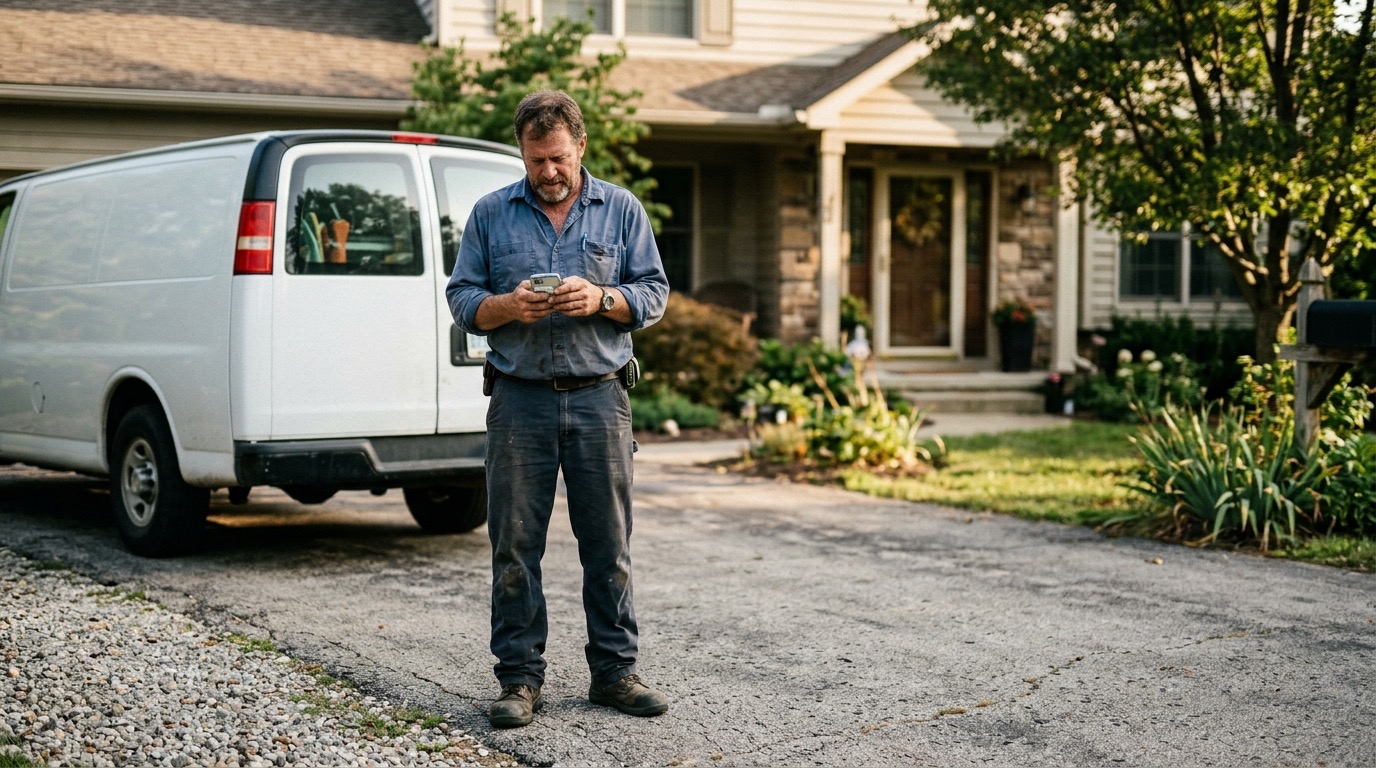
A tile contractor I started working with had a clean website, a solid portfolio, and zero phone calls coming from Google. He was great at the work. Invisible online. Every call he got came from a neighbor recommending him or a Nextdoor post someone dug up.
That works for a while. But it’s not a business you control.
Local SEO for contractors is what changes that. Not in a week, and not without some effort. But once it’s working, the calls come in because someone needed what you do, searched for it, and your name showed up. That’s a different kind of lead than any referral or ad.
Here’s how it actually works.
how homeowners find contractors online
Most people don’t go to Yelp or Angi first. They type something into Google and pick from whatever shows up.
The results they see fall into two categories.
First, the map pack. Three business listings at the top of the page, with a star rating, phone number, and a little map. Those listings come from Google Business Profile. They’re not websites. They’re profiles Google controls, and they show up above almost all the organic website results. If you’re not in that map pack for your core services in your city, you’re invisible to a large portion of your potential customers.
Second, the organic results below the map. Those are regular web pages, and they take longer to rank for. But they matter too, especially for searches like “how much does a new roof cost in Escondido” or “best time of year to repaint a house.”
When someone types “roofer near me” or “fence installer Oceanside” into their phone, both of those result types are competing for their attention. Local SEO is the work of showing up in both.
your Google Business Profile is the first thing to fix
If you haven’t claimed your Google Business Profile, that’s the first move. Go to business.google.com and claim it. If it exists but you’ve never touched it, someone else may have suggested edits to it. Worth checking.
Once you’re in, fill everything out. Every field matters.
Your primary category is the most important one. Not “contractor.” Be specific. “Roofing contractor.” “Fence contractor.” “Tile contractor.” Google uses this to decide which searches you’re eligible to appear for.
Add real photos from real jobs. Before and after shots. Job site photos. A photo of you or your crew. Google favors profiles with photos, and homeowners click on them. Add specific services under your category too. “Deck installation,” “privacy fence,” “custom tile work” are all worth listing.
Post an update a couple times a month. A finished job photo with a short caption is enough. It doesn’t have to be polished. Just real.
the map pack runs on reviews
The three contractors who show up in the map pack almost always have more recent reviews than the ones who don’t.
Not more total reviews necessarily. More recent ones. A contractor with 22 reviews and the last one posted eight months ago will often lose to a competitor with 14 reviews and two posted last week. Google reads recency as a signal that the business is still active and still doing good work.
The system for this doesn’t have to be complicated. Finish a job. If the customer is happy, ask them to leave a review. Text them a direct link to your Google review page. Most people who had a good experience will do it if you ask at the right moment.
One review a week is enough to stay ahead of most competitors. If you’ve been putting this off, starting is the biggest step.
Respond to reviews too, both good ones and bad ones. A short, professional response to a negative review does more for your reputation than the negative review damages it. Homeowners see a business owner who handles problems and they respect it.
service area pages on your website
This one takes a little more work, but it’s what separates contractors who rank in one city from those who rank across a whole region.
If you serve eight cities, you want eight pages on your website. Each one is specific to that city. “Fence installation in Vista.” “Roofing contractor in San Marcos.” Each page talks about the service in the context of that specific area.
These pages don’t need to be long. They need to be real. A paragraph about the work you do there. A couple of photos from jobs in that area if you have them. Your phone number and a contact form.
What you want to avoid is copying the same page eight times and just swapping the city name. Google can tell. The pages should feel different because each area has its own character. Weather in coastal towns is different from inland. HOA rules vary. Soil conditions change how foundations and fencing work. If you write about your actual experience doing work in that city, the page will be both more useful to a homeowner and more trusted by Google.
NAP consistency
NAP stands for name, address, and phone number. These need to be identical across every place they appear online: your website, your Google Business Profile, Yelp, your Facebook page, any directories you’re listed in.
If your business is listed as “Garcia Roofing” in one place and “Garcia Roofing LLC” in another, Google’s confidence in your location data drops. It quietly hurts your rankings.
Search your business name and scan what comes up. If listings are inconsistent, most directories let you claim and correct them.
your website needs to load fast on a phone
Most searches for contractors happen on a mobile device. The homeowner is standing in their backyard, the fence is down, and they’re searching for someone. If your site takes five seconds to load, they’re already on the next result.
Image files that are too large are usually the main culprit. Run your site through Google’s PageSpeed Insights and see where the problems are. The bar isn’t perfection. It’s “loads reasonably fast on a slow mobile connection.” Under three seconds and you’re fine.
what’s realistic on a contractor’s schedule
You’re not going to become a content creator. You don’t need to.
Claim and complete your Google Business Profile. That’s a few hours, one time. Build the habit of asking for a review after a good job. That’s fifteen seconds if you have the direct link saved in your phone. Get your service area pages built. That’s a one-time project. Check your NAP consistency across directories. That’s an afternoon.
After that, the job is maintenance. Photos, occasional updates, steady reviews.
The contractors who get the best results from local SEO aren’t doing more. They’re doing the right things consistently.
common questions
how long does it take to rank in the map pack?
Most contractors see real movement in three to six months if the basics are in place. The first month is setup. By month three you’ll usually see your profile appearing for more searches. By month six, if you’ve been steady with reviews and your website is in decent shape, you’ll likely be showing up in the map pack for your primary services in your main city.
It’s not fast. But it’s not as slow as people expect if you start with the highest-impact work first.
do I need to be on Yelp and Angi and all those other sites?
You don’t need to be active everywhere, but you should be listed accurately. Claim your Yelp profile, make sure the information is correct, and leave it. You don’t need to pay for premium placements there. For most contractors, Google is where the searches happen, and that’s where your energy should go.
what if a competitor has way more reviews than me?
You start where you are and build steadily. One review a week gets you 52 reviews in a year. If your competitor has 80 reviews and you have 12 now, you’re not in a hopeless position. You’re just behind.
The other thing worth knowing: quality and recency matter as much as volume. Recent reviews signal an active business. If your competitor got most of their reviews three years ago and stopped asking, you can close the gap faster than the numbers suggest.